
Back to Journals » International Journal of Nanomedicine » Volume 21
Advancing Arthritis Therapy: The Frontier of Targeted and Responsive Nanomedicine
Authors Zha D, Li G, Jin X, Zhang X 
Received 26 January 2026
Accepted for publication 18 March 2026
Published 30 March 2026 Volume 2026:21 598968
DOI https://doi.org/10.2147/IJN.S598968
Checked for plagiarism Yes
Review by Single anonymous peer review
Peer reviewer comments 2
Editor who approved publication: Prof. Dr. RDK Misra
Dingsheng Zha,1 Guichan Li,2 Xiao Jin,3 Xingwang Zhang2,4
1Department of Orthopedics, The First Affiliated Hospital of Jinan University, Guangzhou, 510630, People’s Republic of China; 2Department of Pharmaceutics, College of Pharmacy, Jinan University, Guangzhou, 511443, People’s Republic of China; 3Department of Chinese Traditional Medicine, The First Affiliated Hospital of Jinan University, Guangzhou, 510630, People’s Republic of China; 4State Key Laboratory of Bioactive Molecules and Druggability Assessment, Jinan University, Guangzhou, 511443, People’s Republic of China
Correspondence: Xingwang Zhang, Email [email protected]
Abstract: Arthritis, a prevalent joint disorder with significant socioeconomic burden, poses considerable therapeutic challenges due to its complex pathophysiology and the limitations of conventional treatments, including systemic toxicity and poor intraarticular retention. Nanomedicine has emerged as a transformative platform to overcome these hurdles, offering precise drug delivery, prolonged retention, and multifunctional therapeutic capabilities. This review systematically summarizes the current landscape and future directions of nanomedicine for arthritis therapy. We first classify and analyze the rational design of four major nanotherapeutic platforms: lipid-based, polymer-based, inorganic, and bioinspired/biomimetic systems. Our discussion highlights their unique mechanisms for targeted delivery, controlled release, and microenvironmental modulation. Subsequently, we elucidate how these engineered nanoplatforms enable multifaceted therapeutic strategies, including immunomodulation, cartilage repair, pannus inhibition, and theranostics. The clinical translation status is critically assessed, acknowledging the promising early-phase validation of candidates like PEGylated liposomes, while also addressing the pivotal translational challenges spanning safety, manufacturing scalability, and biological barriers such as deep tissue penetration and disease heterogeneity. In conclusion, this review underscores the paradigm-shifting potential of nanomedicine in advancing arthritis management from symptomatic relief to disease-modifying interventions and outlines a roadmap for developing next-generation, intelligent nanotherapeutics.
Keywords: arthritis, nanomedicine, drug delivery, targeted therapy, biomimetic strategy, clinical translation
Introduction
Arthritis is a joint disease caused by factors such as inflammation, infection, degeneration, or trauma, clinically characterized by redness, swelling, heat, pain, and dysfunction of the joints.1 Globally, arthritis affects hundreds of millions of people and is a leading cause of disability worldwide, with osteoarthritis (OA) and rheumatoid arthritis (RA) being the most common forms.2,3 In China, arthritis affects over millions of individuals,4 with osteoarthritis representing the most prevalent form, comprising more than 80% of all cases. Approximately 50% of the population aged 50 and above is affected by osteoarthritis, with prevalence rates rising to 90% in women and 80% in men aged 65 or older. Rheumatoid arthritis (RA), another major subtype, exhibits a prevalence of 0.34%–0.36% and affects an estimated 5 million patients in China.5 Arthritis also imposes a significant socioeconomic burden,6 characterized by high medication costs that dominate direct medical expenditures and substantial indirect costs, of which caregiver expenses account for 60.9%. With the ongoing trend of population aging, the burden of arthritis is projected to escalate further by 2046,7 highlighting the imperative for more synergistic and precise interventions to mitigate this pressing public health challenge.
The pathophysiology of arthritis involves a systemic cascade initiated and amplified by synovial inflammation.8 Upon abnormal immune activation, synovial lining cells release key pro-inflammatory cytokines such as TNF-α and IL-1β. These mediators not only directly stimulate synovial hyperplasia to form an inflammatory microenvironment but also induce chondrocytes and synovial fibroblasts to overexpress matrix metalloproteinases and aggrecanases, leading to structural degradation of the articular cartilage extracellular matrix.9 In autoimmune arthritis, activation of CD4+ T cells, particularly the Th17 subset, further drives B cells to produce autoantibodies, resulting in immune complex deposition and the recruitment of macrophages, neutrophils, and other inflammatory cells into the joint cavity.10 This establishes a self-perpetuating cycle of inflammation. Throughout this process, reactive oxygen species (ROS), including superoxide anion (O2−˙), hydrogen peroxide (H2O2), and hydroxyl radical (˙OH), accumulate excessively. These are primarily generated by activated macrophages and neutrophils via the NADPH oxidase system (respiratory burst), as well as by dysfunctional chondrocytes within the joint. The accumulation of these oxidants further amplifying the inflammatory response by activating signaling pathways such as NF-κB, while also directly inducing chondrocyte apoptosis and oxidative damage to matrix components.11 In the typical progression of RA, VEGF-mediated pathological angiogenesis promotes the transformation of synovial tissue into an invasive pannus structure, which erodes subchondral bone and ultimately leads to irreversible joint destruction and loss of function.12 This complex, multi-faceted pathogenesis poses significant challenges for traditional therapeutic approaches, which often struggle to achieve comprehensive and sustained disease control.
Current clinical treatments, including anti-TNF biologics, JAK inhibitors, and corticosteroids, primarily target key inflammatory and immune pathways.13 However, they face multiple practical limitations that constrain their long-term effectiveness and safety. Systemic administration exhibits low bioavailability at the joint site, which limits therapeutic efficacy and is often accompanied by systemic side effects, such as gastrointestinal reactions and hepatorenal toxicity.14 Although intra-articular injections enable local delivery, drugs are rapidly cleared by synovial fluid, resulting in short retention times. This leads to frequent injections, elevated infection risk, and poor tissue specificity toward pathological tissues such as the synovium and cartilage.15 These challenges highlight the urgent need to develop novel delivery systems or nanomedicines that are efficient, long-acting, and tissue-selective.
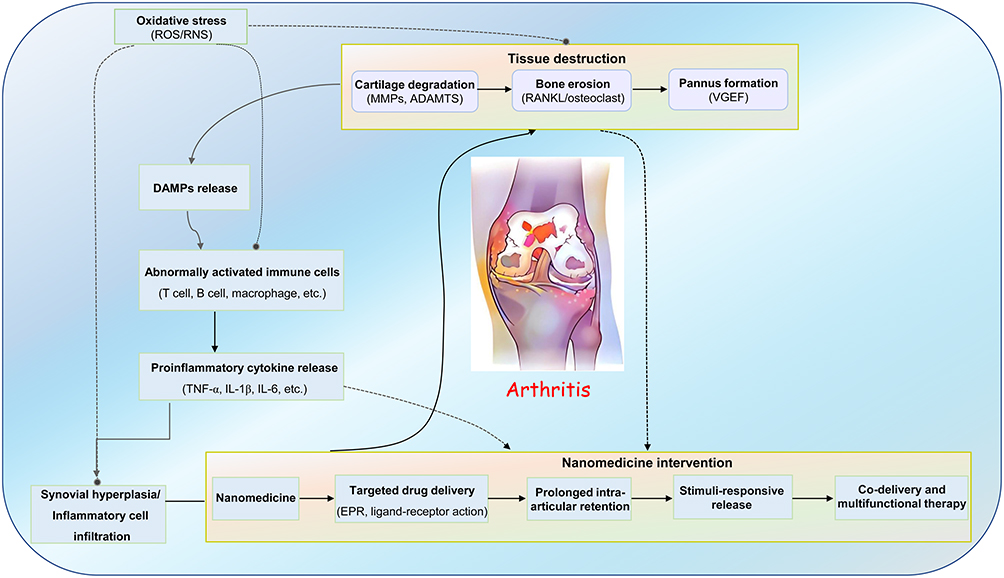 |
Figure 1 Schematic diagram of arthritis pathology progression and nanomedicine intervention mechanisms. |
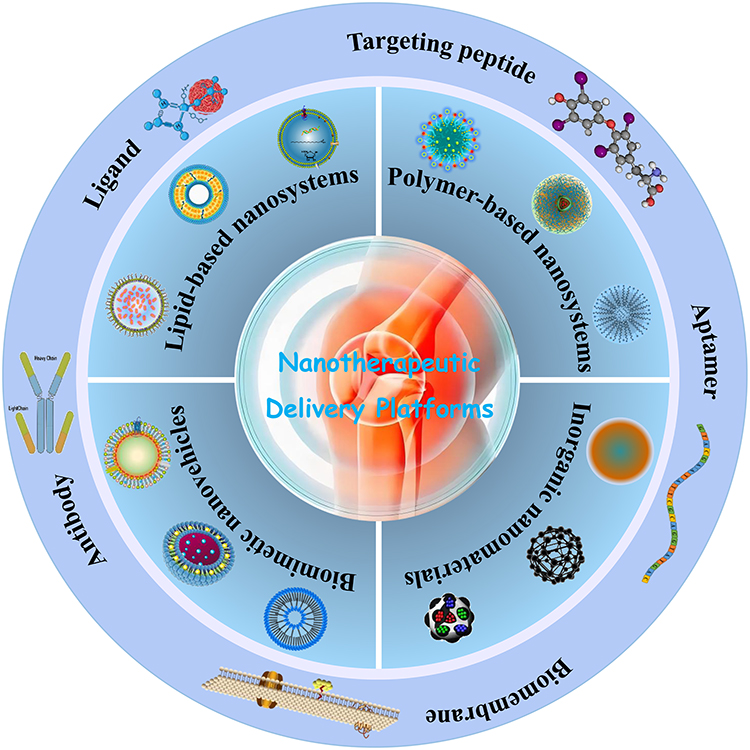 |
Figure 2 Engineered nanotherapeutic delivery systems for arthritis. Schematic representation of the four primary types of nanoplatforms—lipid‑based, polymer‑based, inorganic, and biomimetic nanosystems—all of which can be surface‑engineered with targeting moieties such as ligands, peptides, aptamers, antibodies, or cell membranes to enhance joint‑specific accumulation and therapeutic precision in arthritic tissues. |
 |
Figure 3 Multifaceted therapeutic strategies of nanomedicines in arthritis. |
To address these critical gaps, nanomedicine has emerged as a promising solution, offering distinct advantages through rational design.16–18 As summarized in Figure 1, these key strengths encompass: (1) enhanced targeting ability, which promotes selective drug accumulation at pathological sites such as inflamed synovium and damaged cartilage; (2) prolonged intra-articular drug retention, overcoming rapid synovial clearance to sustain local therapeutic action; (3) controllable or stimuli-responsive drug release, allowing on-demand delivery triggered by disease-specific cues such as pH, enzymes, or reactive oxygen species; and (4) co-delivery and multifunctional capacity, enabling combination therapies and the integration of diagnostic or regenerative functions within a unified platform. Collectively, these features establish nanomedicine as a transformative approach capable of overcoming the inherent limitations of conventional arthritis treatments.19,20
In this context, the present review comprehensively reviews the rational design of advanced nanomedicines for arthritis therapy, with a specific focus on the two most common and pathologically distinct modalities: RA and OA. It classifies current delivery platforms, including lipid-based, polymer-based, inorganic, and bioinspired/biomimetic systems, and analyzes their targeting strategies and stimuli-responsive release mechanisms. The review also evaluates the clinical translation progress of these nanotherapeutics and discusses key challenges in biocompatibility, scalability, and regulatory pathways. Finally, it outlines future directions for developing intelligent, multifunctional nanomedicines to achieve sustained and effective arthritis treatment.
Nanotherapeutic Delivery Platforms for Arthritis
The success of modern drug delivery largely depends on the ability to transport therapeutic agents precisely and controllably to the disease targets. In the case of arthritis, a complex and localized disorder of the joint cavity, conventional administration strategies demonstrate limited therapeutic efficacy, primarily due to their failure to adequately overcome physiological joint barriers and adapt to the unique articular microenvironment. Nanoparticulate-based drug delivery systems have emerged as a transformative approach to overcome these limitations. Classified by material composition and intrinsic characteristics, nanocarriers employed in arthritis therapy can be categorized into four primary types: lipid-based nanosystems, polymer-based nanosystems, inorganic nanomaterials, and bioinspired/biomimetic nanovehicles (Figure 2).
Lipid-based nanosystems, represented by liposomes and lipid nanoparticles, possess inherent advantages in drug delivery due to their high affinity and biocompatibility with cell membranes.21 The core strength of these systems lies in their amphiphilic nature, which enables efficient encapsulation of both hydrophilic drugs (within the inner aqueous compartment) and hydrophobic drugs (embedded in the lipid bilayer), while also providing a convenient interface for surface functionalization. In arthritis treatment, their application strategies are particularly sophisticated. Through adjusting lipid composition and particle size, they can significantly prolong drug retention time within the joint cavity.22 For example, dexamethasone palmitate liposomes have been successfully translated into clinical use for long-acting intraarticular injections in RA. Furthermore, by modifying the lipid carrier surface with targeting ligands (such as RGD peptides), active targeting to inflamed synovium or macrophages can be achieved.23 The most cutting-edge design involves endowing these systems with environmental responsiveness—for instance, constructing ROS-responsive liposomes that specifically rupture and release drugs only in the high reactive oxygen species environment of inflammatory sites, greatly enhancing the precision and safety of treatment.24
Polymer-based nanosystems, with their highly customizable chemical structures, serve as a potential platform for programmed drug release. Synthetic polymers, exemplified by PLGA, offer precisely tunable degradation periods.25,26 This enables smooth drug release profiles ranging from weeks to months, perfectly aligning with the long-term management needs of chronic arthritis. Meanwhile, natural polymers demonstrate unique biological advantages. Positively charged chitosan can specifically adhere to the negatively charged cartilage matrix through electrostatic interactions, achieving natural cartilage targeting.27 Hyaluronic acid, a natural component of joint synovial fluid, acts as an ideal ligand for CD44 receptor. It actively recognizes and targets activated inflammatory cells and synovial cells that overexpress CD44 in arthritis, making it a standout material for synovium-specific delivery.28 These polymer nanoparticles are not merely inert carriers. Often, the materials themselves participate in synergistic therapeutic effects, contributing to anti-inflammatory or reparative processes.
Inorganic nanomaterials, with their unique and stable physicochemical properties (such as optical, magnetic, and catalytic capabilities), have opened new paradigms for arthritis treatment that go beyond simple drug delivery. For instance, mesoporous silica nanoparticles possess a large specific surface area and well-ordered pore channels, enabling not only efficient drug loading but also co-delivery of imaging agents, allowing for visualized monitoring of the treatment process (theranostics).29–31 More revolutionary are photothermal agents like gold nanorods and black phosphorus nanosheets, which can efficiently generate heat under near-infrared light irradiation.32,33 This heat can be directly used for photothermal ablation of abnormal synovial pannus or induce immunomodulation through thermal therapy. Additionally, cerium oxide nanoparticles exhibit potent enzyme-mimicking activity (nanozymes). Due to the mixed valence states (Ce3+/Ce4+) on their surface, they can continuously scavenge excess ROS in the joint by dismutating superoxide anion (O2−˙) via superoxide dismutase (SOD)-like activity and decomposing hydrogen peroxide (H2O2) via catalase (CAT)-like activity.34 This dual antioxidase capacity allows them to intervene at the root of oxidative stress-driven inflammation and cartilage degradation, showcasing the novel concept of “catalytic therapy” that targets both the primary and secondary ROS species generated by activated immune cells.
Bio-derived nanosystems represent the pinnacle of biomimetic nanotechnology, leveraging the body’s own components as delivery vehicles to achieve ultimate biocompatibility and intelligent targeting. Exosomes are natural nanovesicles secreted by cells, particularly those derived from mesenchymal stem cells, which are inherently rich in therapeutic nucleic acids and proteins.35,36 They possess potent intrinsic anti-inflammatory and cartilage-repairing capabilities while serving as near-perfect natural carriers for loading exogenous drugs. Cell membrane camouflaging nanotechnology is even more innovative.37,38 By enveloping synthetic nanoparticles with the cell membranes of macrophages or neutrophils, the resulting biomimetic nanoparticles perfectly inherit the chemotactic ability of the source cells toward inflammatory sites,39 achieving inflammation targeting akin to “using the enemy against itself”. Meanwhile, nanoparticles coated with chondrocyte membranes may enable homing to damaged cartilage, providing unprecedented precision tools for cartilage-specific repair.
As summarized in Table 1, the four major classes of nanoplatforms each offer distinct advantages tailored to specific therapeutic needs. Collectively, they form a powerful and versatile “nanotechnology toolbox” for arthritis therapy. The membrane-mimicking properties of lipid-based systems, the programmable nature of polymer-based systems, the multifunctionality of inorganic materials, and the ultimate biomimetic capabilities of bio-derived systems may address the challenges of drug delivery for arthritis from different dimensions.
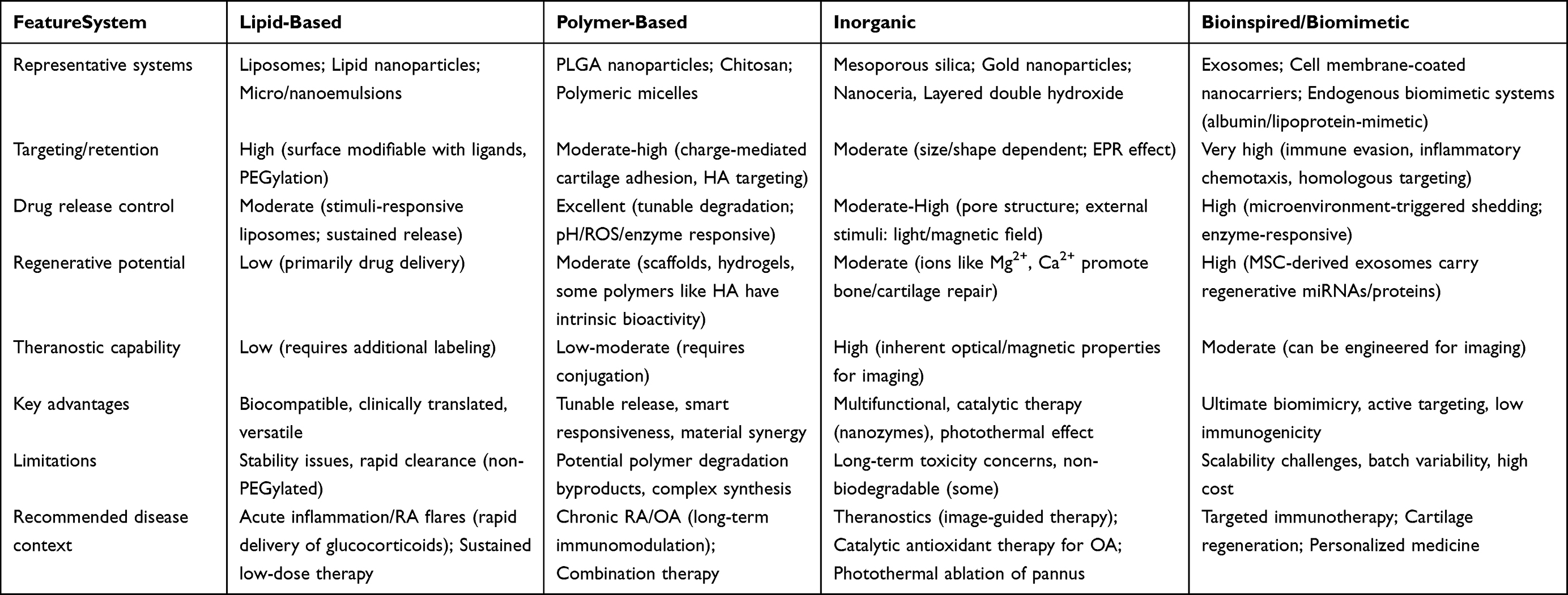 |
Table 1 Comparative Features of Nanoplatforms for Arthritis Therapy |
Therapeutic Strategies and Action Mechanisms of Nanomedicines
The significance of nanomedicines in arthritis treatment extends beyond mere drug delivery, encompassing their capacity to enable precise and synergistic therapeutic interventions rooted in a profound comprehension of disease pathophysiology. The following sections, along with Figure 3, elaborate how nanomedicines, through multidimensional and intelligently engineered strategies, achieve comprehensive modulation of the intricate pathological cascades in arthritis.
Targeted Modulation of the Immune/Inflammatory Microenvironment
The core pathological feature of arthritis lies in immune system dysregulation and the persistence of chronic inflammatory responses. Nanomedicines can precisely intervene in this process, with designs directly targeting key cells and molecules within the inflammatory microenvironment. By specifically targeting M1-type pro-inflammatory macrophages, nanocarriers can deliver regulatory drugs to induce the transformation of these cells into anti-inflammatory and tissue-reparative M2-type macrophages,40,41 thereby reshaping immune balance at its source.42 For instance, nanomedicines have been engineered to deliver therapeutic agents such as celastrol, berberine, or specific nucleic acids (siRNA/miRNA) that modulate key signaling pathways.23,43,44 These interventions often involve the activation of AMPK, or the inhibition of the NF-κB pathway, leading to a metabolic and functional shift in macrophages. This targeted delivery ensures that pro-inflammatory M1 macrophages are reprogrammed towards an anti-inflammatory M2 phenotype, enhancing the resolution of inflammation and promoting tissue repair in the arthritic joint. Simultaneously, nanoplatforms can precisely neutralize core inflammatory mediators, such as TNF-α, at the lesion site by efficiently loading or surface-modifying cytokine inhibitors, effectively blocking the cascade amplification of inflammation.45,46 Furthermore, by delivering inhibitors of key signaling pathways such as the NLRP3 inflammasome,47 nanomedicines can curb the initiation and progression of inflammation from upstream, achieving deep modulation of the immune microenvironment.
Promotion of Cartilage Repair and Regeneration
Ideal arthritis treatment requires not only the inhibition of tissue destruction but also the active promotion of repair and regeneration of damaged cartilage. Nanomedicines demonstrate unique advantages in this field, serving as multifunctional platforms to support cartilage regeneration. By loading specific growth factors or genetic materials, nanocarriers can guide mesenchymal stem cells to home to the injury site and promote their differentiation into functional chondrocytes, thereby replenishing the lost cell population.48,49 At the genetic level, nanocarriers can deliver protective genes to enhance the anabolic activity of chondrocytes or deliver gene-silencing tools to inhibit the overexpression of catabolic enzymes, achieving long-term regulation of cartilage homeostasis.50,51 Additionally, injectable nanocomposite hydrogels can form a biomimetic three-dimensional microenvironment within the joint cavity, providing physical support and biochemical signals for cell adhesion, proliferation, and extracellular matrix secretion, synergistically promoting in situ tissue regeneration.52
Inhibition of Pannus Formation and Synergistic Analgesia
In inflammatory arthritis such as RA, the abnormal proliferation of synovial pannus is a key driver of joint destruction and is accompanied by significant pain. Nanomedicines provide targeted solutions for this. Through surface functionalization, nanoparticles can actively recognize and accumulate at neovascular sites, precisely delivering anti-angiogenic drugs to inhibit the growth of pathological pannus, thereby cutting off its “nutrient” supply to inflammation and destruction processes.53 For pain management, nanotechnology-based sustained-release systems can maintain therapeutic levels of analgesic drug concentrations within the joint cavity, achieving localized analgesia lasting for weeks.54 This not only significantly improves patients’ quality of life but also reduces reliance on systemic analgesics and their associated side effects.
Orchestration of Theranostic Platforms
The inherent diverse physicochemical properties of nanomaterials make it possible to integrate diagnostic and therapeutic functions into a single platform, driving arthritis management toward precision and visualization. Theranostic nanoplatforms, by co-loading therapeutic drugs and imaging probes (such as MRI contrast agents or fluorescent dyes), enable non-invasive, real-time visualization of the distribution and targeting efficiency of nanomedicines within the joint.55 More importantly, such platforms allow for the dynamic assessment of changes in lesions (such as the degree of inflammation reduction or cartilage repair) during treatment,56 providing objective evidence for efficacy evaluation and laying the technical foundation for the individualized and dynamic adjustment of treatment plans.
Through the synergistic application of the above multifaceted strategies, nanomedicines are systematically transforming the treatment paradigm for arthritis, shifting from passive symptom relief to active intervention in disease progression. The intelligent integration and individualized implementation of these strategies represent the core direction for the future development of nanomedicine in arthritis.
Engineering Nanomedicines for Arthritis Therapy
The rise of nanotechnology is driving arthritis therapy toward greater precision and intelligence. Through the design of diverse platforms such as lipid carriers, polymeric nanoparticles, inorganic nanosystems, and bioinspired vehicles, efficient targeted delivery and programmed release of anti-inflammatory drugs can be achieved, which is providing a powerful tool to overcome the bottlenecks of traditional treatments.
Lipid-Based Nanoplatforms
As a pivotal drug delivery platform, lipid-based nanoplatforms encompass a wide range of lipid materials, from natural to fully synthetic ones, including phospholipids, triglycerides, and polymeric lipids.57,58 Their inherent biocompatibility, biodegradability, and flexible modifiability for surface render them a cornerstone of nanomedicine engineering. In the field of arthritis therapy, these properties have been successfully translated into therapeutic advantages, enabling lipid nanocarriers to efficiently deliver drugs to inflamed joints and achieve precise treatment.59
Lipid-based nanoplatforms have emerged as versatile and effective delivery systems for targeted arthritis therapy, integrating various strategies to enhance therapeutic precision and reduce systemic toxicity. One prominent approach involves ligand-mediated active targeting, exemplified by VCAM-1-targeted methotrexate (MTX)-loaded lipid nanoparticles60 and folate receptor-targeted MTX nanoemulsions,61 which exploit receptor overexpression on activated synovial fibroblasts or macrophages for enhanced joint accumulation. Complementing this, endogenous albumin-hijacking strategies, such as dexamethasone-loaded liposomes functionalized with an albumin-binding domain, extend circulation and leverage albumin’s natural tropism to inflammatory sites.62 Furthermore, combination therapies co-delivering agents like curcumin and leflunomide within phytosomes demonstrate improved pharmacokinetics and synergistic anti-inflammatory effects.63 These platforms collectively address key challenges in RA treatment, including poor bioavailability, non-specific distribution, and narrow therapeutic windows.
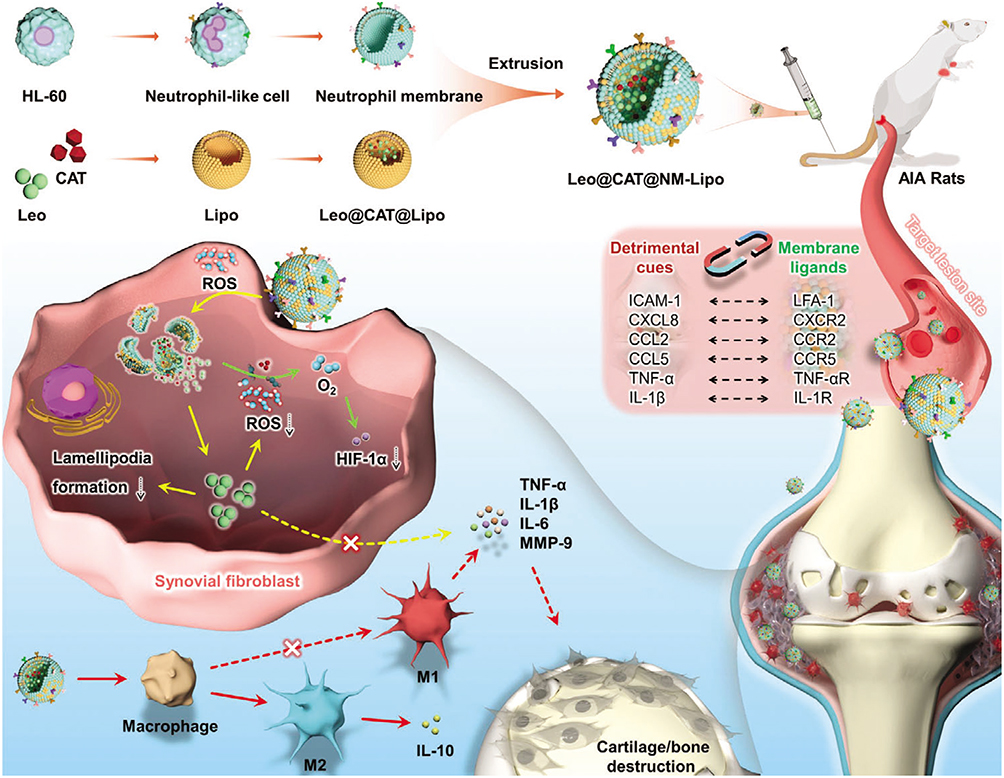 |
Figure 4 Engineering of multi-pronged nanoplatform (Leo@CAT@NM-Lipo) for synergistic therapy against rheumatoid arthritis via inflammatory lesion targeting, ROS-responsive drug release, ROS scavenging, immunoregulation, and hypoxia relief. Adapted from Tang Z, Meng S, Yang X, et al. Neutrophil-mimetic, ROS responsive, and oxygen generating nanovesicles for targeted interventions of refractory rheumatoid arthritis. Small. 2024;20(20):e2307379. http://creativecommons.org/licenses/by/4.0/.64 licensed under CC-BY 4.0. |
A significant advancement in this field is the development of biomimetic, microenvironment-responsive systems, with a notable example featuring a neutrophil-mimetic lipid nanoplatform. This sophisticated design cloaks leonurine and catalase co-loaded nanoliposomes with neutrophil membranes, inheriting their innate inflammation tropism for targeted joint delivery.64 As illustrated in Figure 4. The system is engineered to be responsive to the reactive oxygen species (ROS)-rich arthritic microenvironment, where catalase converts hydrogen peroxide into oxygen, simultaneously alleviating hypoxia and triggering drug release. Moreover, the neutrophil membrane acts as a decoy, neutralizing pro-inflammatory cytokines and chemokines. In preclinical models, this multifunctional system synergistically alleviates joint swelling, reduces bone erosion, and repolarizes macrophages through combined anti-inflammatory, antioxidant, and immunomodulatory actions, showcasing a paradigm shift toward intelligent, feedback-responsive nanomedicine.
The evolution of lipid nanoplatforms for arthritis thus reflects a trajectory from simple passive targeting to advanced bio-hybrid systems capable of active homing, microenvironmental sensing, and multi-modal therapy. By merging materials science with principles of immunology and cell biology, these platforms—from peptide-targeted nanoparticles to cell membrane-camouflaged vesicles—offer increasingly sophisticated solutions to overcome biological barriers and enhance site-specific efficacy.
Polymer-Based Nanoplatforms
Polymer-based nanoplatforms constitute a pivotal class of drug delivery vehicles, engineered from biocompatible and frequently biodegradable macromolecules including PLGA, chitosan, and PEG.65 These systems are distinguished by their highly customizable architecture, enabling precise modulation of drug release profiles and straightforward conjugation of targeting moieties. In RA therapy, such design adaptability has been crucial for developing “smart” nanocarriers capable of responding to inflammatory cues and selectively accumulating in diseased joints, thus advancing therapeutic precision and safety.66
Polymer-based nanoplatforms have demonstrated considerable potential as versatile and effective delivery systems for targeted arthritis therapy, integrating multiple strategies to enhance therapeutic precision, improve bioavailability, and reduce systemic toxicity. One notable example involves the use of hyperbranched semiconducting polymer nanoparticles (HSP-PEG-NPs) for both imaging and therapy in RA.67 HSP-PEG-NPs were engineered to co-deliver the radioisotope 99mTc for SPECT imaging and MTX for RA treatment. Upon intravenous administration, these nanoparticles selectively accumulated in inflamed joints via an EPR-like effect and showed significant RA alleviation with reduced systemic toxicity. Another innovative “drug in therapeutic polymer” strategy was reported by Yin’ group, where sinomenine (Sin) was loaded into oxidation-responsive hyaluronic acid-based nanoparticles (PAM-HA@Sin NPs).68 The PAM-HA carrier not only served as a drug vehicle but also exhibited intrinsic therapeutic effects, including ROS scavenging, joint lubrication, and cartilage binding via alendronate moieties. Further extending the concept of microenvironment-responsive polymer systems, a ROS-sensitive nanoplatform was developed for osteoarthritis (OA) therapy.69 In this study, astaxanthin and rapamycin were co-encapsulated in thioketal-containing polymeric nanoparticles (NP@PolyRHApM) to reprogram macrophage polarization and mitigate oxidative stress. The nanoparticles disassembled under high ROS conditions in M1 macrophages, releasing astaxanthin to scavenge ROS and rapamycin to induce autophagy. This dual action promoted M1-to-M2 repolarization, reduced synovitis, and protected chondrocytes in an ACLT-induced OA mouse model. In another RA-targeted approach, a pH-responsive lipid-polymer hybrid nanoparticle system (Pae-PPNPs-DS) was designed to actively deliver paeoniflorin to macrophages via dextran sulfate-mediated targeting of scavenger receptor class A type I.70 As reported, the nanoparticles released drug in acidic inflammatory environments and effectively modulated macrophage polarization by regulating the STAT signaling pathway. In CIA rats, Pae-PPNPs-DS reduced joint swelling, suppressed pro-inflammatory markers (TNF-α, IL-1β, iNOS), and promoted anti-inflammatory markers (IL-10, Arg-1), demonstrating the efficacy of combined active targeting and microenvironment-triggered release. Meanwhile, in addition to the MMP-sensitive macrophage-targeted CoQ10 delivery system that utilizes PEG cleavage for PS-mediated phagocytosis,71 another multifunctional polypyrrole-based platform (PPy–FePi–MTX NPs) has been developed to enhance RA therapy by simultaneously inducing apoptosis and ferroptosis in M1 macrophages.72 These “smart” polymer-based designs demonstrate how nanoplatforms can integrate microenvironmental responsiveness, multimodal therapeutic actions, and precise targeting to effectively eliminate inflammatory macrophages and improve RA treatment.
Most recently, several studies have further demonstrated the versatility and therapeutic potential of polymer-based nanoplatforms for arthritis treatment through innovative design strategies. For instance, Wu et al73 reported a redox- and gene-regulating polymeric nanoparticle system for osteoarthritis (OA) therapy. The platform was constructed from antioxidant TEMPO-PEG-PLGA and cationic PEG-PLG A-OA9, enabling co-delivery of the ROS scavenger tetramethylpiperidoxyl (TEMPO) and MMP-13-targeting siRNA (siMMP-13). The nanoparticles effectively neutralized excess reactive oxygen species and silenced catabolic gene expression in chondrocytes. In a DMM-induced OA mouse model, the system showed strong anti-inflammatory and cartilage-protective effects, attenuating cartilage degradation and subchondral bone remodeling. Impressively, a self-anti-inflammatory polymer nanocarrier based on caffeic acid was developed for enhanced RA therapy.74 The caffeic acid-derived polyphenol polymer (PCOH) was used to construct nanoparticles for the delivery of MTX. These MTX@PCOH NPs exhibited rapid accumulation and prolonged retention in inflamed joints of collagen-induced arthritis (CIA) mice via the EPR effect. PCOH NPs inhibited LPS-stimulated iNOS expression and pro-inflammatory macrophage polarization in vitro. In vivo, even at a low MTX dose (2.5 mg/kg), MTX@PCOH NPs significantly alleviated joint swelling, reduced bone erosion, and decreased levels of pro-inflammatory cytokines (TNF-α, IL-1β, iNOS), demonstrating synergistic therapeutic effects between the active carrier and the drug with minimal systemic toxicity (Figure 5).
 |
Figure 5 Engineering MTX@PCOH NPs for arthritis rheumatoid treatment: (A) Schematic of PCOH NPs and MTX@PCOH NPs aggregating in inflamed joints; (B) Biodistribution of Dir@PCOH NPs in vivo in CIA mice (n = 3, ***P < 0.001, unpaired Student’s t-test); and (C) Representative hind paw images of different groups on day 51 after treatment. Adapted from Dai C, Wang L, You X, et al. Coffee-derived self-anti-inflammatory polymer as drug nanocarrier for enhanced rheumatoid arthritis treatment. Chin Chem Lett. 2025;36:109869. http://creativecommons.org/licenses/by/4.0/.74 licensed under CC-BY 4.0. |
Together, these studies chronicle the transformative progression of polymer-based nanoplatforms from passive carriers to sophisticated, multifunctional systems capable of active targeting, microenvironmental sensing, and combined therapeutic-imaging functions. By leveraging materials chemistry, immunology, and disease biology, polymer nanoplatforms offer promising strategies to overcome biological barriers, enhance site-specific efficacy, and improve outcomes in arthritis therapy.
Inorganic Nanoplatforms
Inorganic nanoplatforms serve as a potential alternative to their organic counterparts in arthritis treatment, characterized by their tunable morphology, superior physicochemical stability, and multifunctional capabilities.75 These nanomaterials, such as mesoporous silica nanoparticles, selenium nanoparticles, gold nanoparticles, ion nanoparticles, and layered double hydroxides, offer unique advantages including high drug-loading capacity, controllable degradation profiles, and responsiveness to external stimuli (eg., pH, redox, or magnetic fields). In the context of arthritis therapy, these platforms have been engineered to not only deliver anti-inflammatory drugs with enhanced pharmacokinetics, but also to integrate diagnostic imaging (eg., via MRI or photoacoustic contrast) and photothermal or catalytic therapeutic functions. This convergence of targeting, treatment, and imaging within a single inorganic carrier underscores its potential for developing combined theranostic strategies in managing joint inflammation and damage.76
In parallel with the advances in polymer-based delivery systems, inorganic nanoplatforms have emerged as highly promising candidates for arthritis therapy. These platforms often combine structural versatility, catalytic functions, and inherent immunomodulatory or osteogenic effects, enabling multifunctional approaches to treat complex arthritic conditions. One characteristic case is the use of hydroxyapatite (HA)-based nanoparticles for targeted RA therapy.77 The engineered nanocarrier functionalized with hyaluronic acid and loaded with MTX and teriflunomide not only halted the disease progression and promoted articular regeneration, but also reduced the hepatotoxicity caused by traditional treatments. This system exemplifies how inorganic carriers can be surface-engineered for active targeting and combination drug delivery. Another innovative approach leverages mesoporous silica hybrid nanoparticles for combined phototherapy, hypoxia-activated chemotherapy, and RNA interference in RA.78 The photosensitizer PCPDTBT-loaded mesoporous silica nanoparticles coated with branched polyethyleneimine-folic acid (PEI-FA) to co-deliver tirazapamine and Mcl-1 siRNA. Under NIR irradiation, the nanoplatform enabled photothermal/photodynamic therapy, hypoxia-activated drug release, and gene silencing, collectively promoting apoptosis in activated macrophages and ameliorating RA symptoms in vivo. Similarly, metal–natural product coordination complexes have been designed to counteract oxidative stress and modulate immune responses in RA.79 The synthesized ultrasmall iron–quercetin natural coordination nanoparticles (Fe–Qur NCNs) preserved the antioxidant capacity of quercetin while concurrently demonstrating improved water solubility and biocompatibility. These nanoparticles effectively scavenged ROS, inhibited NF-κB activation, promoted M2 macrophage polarization, and reduced osteoclastogenesis, leading to significant alleviation of joint inflammation and bone erosion in a collagen-induced arthritis model. For osteoarthritis therapy, magnesium oxide (MgO)-based nanocomposites have shown promise in promoting cartilage–bone synergy. Zheng et al80 engineered microspheres loaded with nano-MgO for intra-articular delivery of Mg2⁺ ions. The sustained release of Mg2⁺ enhanced chondrogenic differentiation, inhibited osteoclast formation, and activated the PI3K/AKT pathway. Lately, a sophisticated inorganic nanocatalytic platform, nanoceria-loaded magnesium–aluminum layered double hydroxide (LDH–CeO2) system, has been reported for RA therapy.81 It strategically targets two key pathological features of RA: acidic microenvironment and oxidative stress. The alkaline LDH neutralizes osteoclast-derived H⁺, restoring the antioxidant activity of CeO2 nanoparticles in acidic conditions. Concurrently, released Mg2⁺ drives M2 macrophage polarization and osteogenesis, while CeO2 scavenges ROS to reinforce anti-inflammatory repolarization.
In the context of OA, inorganic nanoparticles have also shown systemic and local therapeutic efficacy. Gold nanoparticles (GNPs) have been shown to mitigate OA progression via modulation of the “microbiota–gut–joint” axis.82 In an ACLT-induced murine model, oral administration of GNPs significantly attenuated cartilage degradation and subchondral bone loss, effects attributed to their ability to beneficially reshape gut microbial composition. Likewise, polydopamine-coated selenium nanoparticles (PDA-SeNPs) demonstrate enhanced chondroprotective effects in OA.83 The PDA coating improves their stability and biocompatibility, which in turn better supports chondrocyte viability, upregulates chondrogenic markers, scavenges reactive oxygen species, and promotes cartilage repair. Applying this inorganic paradigm in RA, iron-doped carbon dots synthesized from traditional Tibetan medicinal materials (magnetite and medicated leaven) also exhibit noticeable therapeutic efficacy.84 Orally administered MM-CDs significantly alleviated joint swelling, inflammatory infiltration, and bone-cartilage damage in a Freund’s adjuvant-induced RA model, performing comparably to MTX (Figure 6). Mechanistically, MM‑CDs suppress neutrophil‑driven inflammation by downregulating NETosis markers, promoting apoptosis, and reducing autophagy‑related proteins, thus disrupting the autophagy–NETosis axis. Importantly, no hepatorenal toxicity was detected, highlighting their favorable safety.
 |
Figure 6 Fe-doped carbon dots fabricated from magnetite and medicated leaven (MM-CDs) alleviated rheumatoid arthritis: (A) Preparation of MM-CDs; (B) Photos of the mouse ankle joint treated with MM-CDs at low (L), medium (M) and high (H) dose or methotrexate (MTX); and (C) 3D images of the hind paw and ankle joint, arrows indicating bone erosion. Adapted from Wang H, Wang L, Yan A, et al. Fe-doped carbon dots alleviated rheumatoid arthritis by inhibiting neutrophil NETosis and autophagy. ACS Biomater Sci Eng. 2025;11;3666−3681. http://creativecommons.org/licenses/by/4.0/.84 licensed under CC-BY 4.0. |
The abovementioned cases illustrate the versatility and therapeutic potency of inorganic nanoplatforms in arthritis treatment. By integrating catalytic, ionic, structural, and targeting functionalities, inorganic systems can simultaneously address multiple pathological processes, such as oxidative stress, acidosis, immune dysregulation, and bone erosion, offering a robust and multifunctional arsenal against both RA and OA.
Bioinspired/Biomimetic Nanoplatforms
Bioinspired/biomimetic nanoplatforms represent a transformative frontier in arthritis therapy, engineered by emulating natural biological structures and processes such as cell membranes, viral capsids, or inflammatory tropism.85 These systems are distinguished by their innate ability to evade immune clearance, selectively engage with pathological cells, and dynamically respond to the arthritic microenvironment. In RA treatment, this biomimetic design has been pivotal for creating intelligent nanomedicines that achieve precise targeting of inflamed joints and context-specific drug release, thereby significantly enhancing therapeutic efficacy while minimizing systemic toxicity.
Bioinspired nanoplatforms have evolved beyond simple drug carriers to become sophisticated systems capable of precise subcellular targeting. A representative example involves engineering platelet microparticle membrane (PMMs)-camouflaged nanoparticles to deliver all-trans retinoic acid (ATRA) directly to the Golgi apparatus of pathogenic synovial fibroblasts in RA.86 This strategy exploits the natural affinity of PMMs for inflamed sites and RA synovial fibroblasts (RASFs), while a conjugated Golgi-targeting peptide ensures retrograde transport to the specific organelle. The ensuing structural disruption of the Golgi by ATRA effectively shuts down the secretion of critical pathogenic proteins (eg., IL-6, MMPs), thereby attenuating synovitis and bone erosion in vivo. Similarly, for OA treatment, a decorin-derived cartilage-binding peptide was used to functionalize lipid nanoparticles, granting them high affinity for the type II collagen-rich extracellular matrix.87 This modification not only enabled prolonged retention within the avascular cartilage but also facilitated deep penetration into the dense matrix, allowing for sustained release of chondrogenic factors (TGF-β3 and kartogenin) to recruit endogenous stem cells and promote hyaline-like cartilage regeneration in full-thickness defects.
A central theme in biomimetic nanomedicine is the repurposing of natural cell membranes to bestow nanoparticles with complex biological functions. This is vividly demonstrated in strategies for RA immunotherapy. For instance, erythrocyte membranes were used to camouflage self-assembled nanoparticles of celastrol and bilirubin, significantly extending systemic circulation and reducing immunogenicity.43 Further functionalization with hyaluronic acid added active targeting to inflamed joints. This design synergized STING pathway inhibition with reactive species clearance to remodel the joint microenvironment. Another approach utilized the homologous targeting capability of fibroblast-like synoviocyte membrane proteins, fusing them with liposomes loaded with chrysin.88 These biomimetic vesicles efficiently honed to inflamed synovium, where drug release inhibited the HIF-1α/iNOS/NLRP3 inflammatory axis. Aligned with this biomimetic membrane-coating strategy, Zhang et al89 developed a dual-engineered plant-derived exosome-like nanovesicles (MOE@EM) for RA therapy. UV irradiation of Morinda officinalis roots enhanced MOE yield, antioxidant activity, and M1-to-M2 macrophage repolarization via Wnt/β-catenin suppression. Erythrocyte membrane camouflage further reduced immunogenicity, prolonged circulation, and promoted joint accumulation via the EPR effect, ultimately alleviating arthritis symptoms and modulating synovial immunity without systemic toxicity in vivo.
Perhaps the most dynamic application involves macrophage membranes used as a reversible cloak. These membranes provide long circulation and inflammation targeting but are strategically shed within the oxidative joint milieu.90 The shedding is triggered by oxygen bubbles generated from catalase-mediated decomposition of excess H2O2, subsequently exposing a cationic core for efficient macrophage uptake and siRNA delivery. This elegantly solves the inherent conflict between stealth and cellular internalization in membrane-coated systems. The most advanced frontier involves integrating multiple therapeutic components into a single, cooperative biomimetic platform that performs sequential, synergistic actions. A paradigm was manifested by macrophage membrane-coated, nanozyme-incorporated metal-organic frameworks (mZPMG NPs).91 This platform executes a “dual-pronged attack” on RA by simultaneously targeting hyperproliferative synovial fibroblasts and the inflammatory immune microenvironment. The system features a ZIF-8 core that co-encapsulates MTX and glucose oxidase (GOx), along with surface-anchored platinum nanoparticles (Pt NPs) serving as a nanozyme, cloaked with a macrophage membrane to ensure targeted delivery to inflamed joints. Upon localization, Pt NPs scavenge ROS that alleviates oxidative stress and inflammation while generating oxygen. This oxygen relieves hypoxia and fuels GOx to convert glucose into gluconic acid and H2O2, thereby starving glycolytic cells through glucose depletion. Following this biomimetic strategy, a complementary platform based on cerium oxide nanozymes (MCB@MMs) was recently developed.92 It employs a BSA-templated core co-encapsulating MTX and Ce nanozymes, which is camouflaged with a macrophage membrane for targeted delivery. The Ce3+/Ce4+ redox center mimics SOD/CAT activity to scavenge ROS and generate oxygen, thus alleviating hypoxia and suppressing the HIF-1α/MAPK inflammatory pathway. This effect synergizes with MTX to promote M1-to-M2 macrophage repolarization and remodel the synovial immune microenvironment. The macrophage membrane coating further enhances joint-specific accumulation and mitigates immunogenicity. In AIA rats, MCB@MMs demonstrated pronounced efficacy in alleviating arthritis symptoms and suppressing bone erosion (Figure 7), underscoring the therapeutic potential of integrating traditional drugs, functional nanozymes, and biomimetic membrane strategies for reprogramming the RA microenvironment.
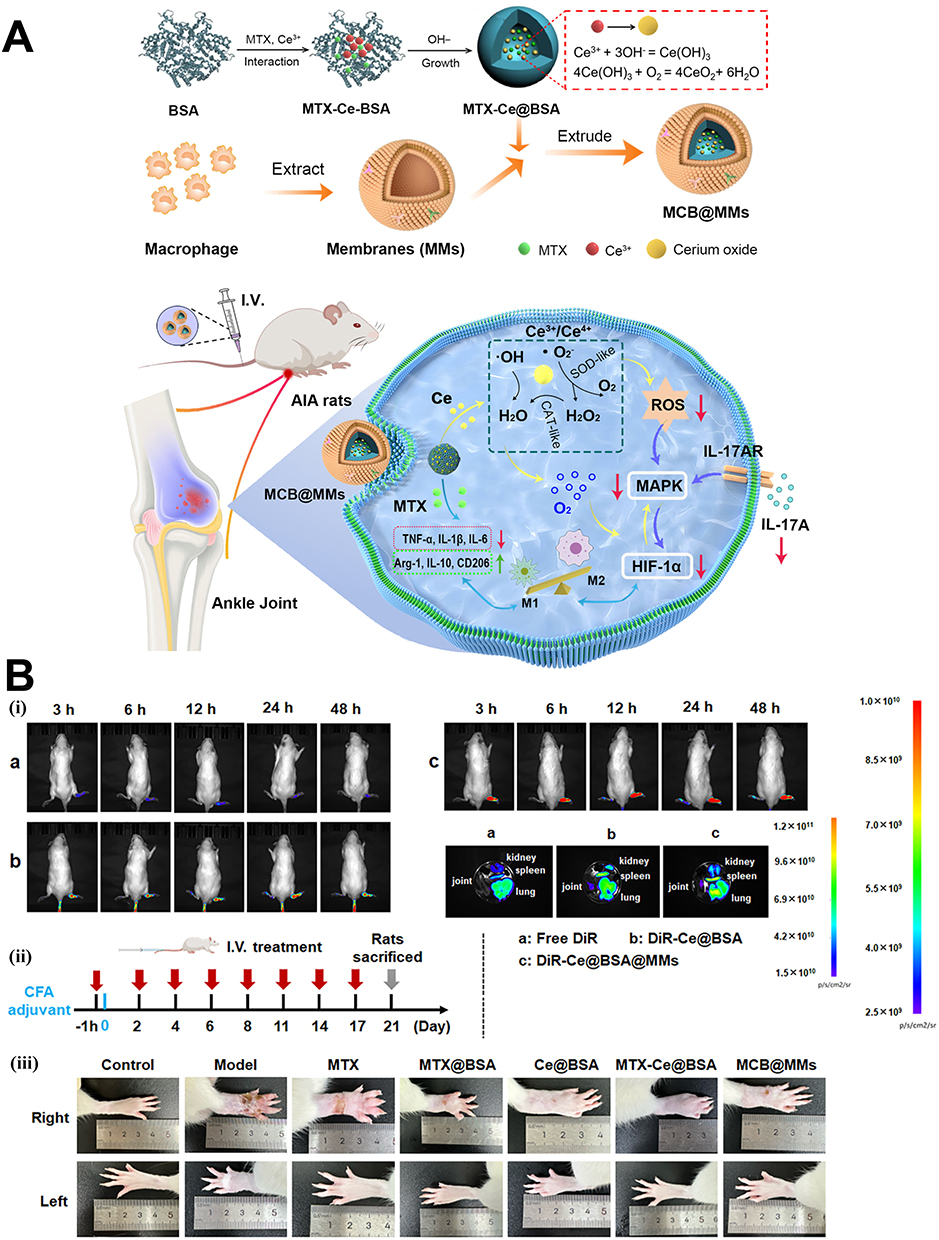 |
Figure 7 Engineering methotrexate and cerium oxide self-assembly nanoparticles with surface modification by macrophage membrane (MTX-Ce@BSA@MMs) for RA therapy: (A) Schematic of MCB@MMs preparation and therapeutic mechanisms; (B) In vivo imaging and evaluation of therapeutic effects in AIA rats: (i) biodistribution of nanodevices in vivo and ex vivo fluorescence imaging of major organs and representative images of rat hind paws post-treatment; (ii) the treatment protocol for AIA rats; and (iii) representative images of rat hind paws post-treatment. Adapted from Lv L, Qiu X, Chen W, et al. Oxygen-self-supplying biomimetic nanozymes synergize with methotrexate to reprogram macrophage polarization for rheumatoid arthritis therapy. Acta Biomater. 2026;209:566–582. http://creativecommons.org/licenses/by/4.0/.92 licensed under CC-BY 4.0. |
The progression of biomimetic nanoplatforms for arthritis therapy, as evidenced by above studies, reveals an evolution from simple targeted delivery systems to sophisticated, multifunctional constructs that mimic biological processes, respond to pathological microenvironments, and execute combined therapeutic actions. These platforms collectively offer promising avenues for developing more effective, targeted, and safe treatments for arthritis.
Clinical Translation Status and Challenges
The clinical translation of nanomedicines for arthritis has entered a pivotal, early-stage clinical validation phase. This is exemplified by the first completed randomized controlled trial (2022, NCT00241982) of intravenous pegylated liposomal prednisolone (Nanocort).93 This Phase II study demonstrated superior Week 1 “European League Against Rheumatism” (EULAR) response rates compared to standard intramuscular methylprednisolone. It successfully validated the concept of using long-circulating liposomes for targeted glucocorticoid delivery, enhancing therapeutic efficacy without significantly increasing overall systemic adverse events, though a higher incidence of infusion-related hypersensitivity reactions was noted. While this trial represents a milestone as the first proof-of-concept in a substantial patient cohort, no nanodrug has achieved global regulatory approval for routine clinical use in arthritis. The broader field remains in pre-clinical exploration for osteoarthritis. Furthermore, results from another completed trial on oral gold nanoparticles (NCT05347602) are yet to be reported (https://clinicaltrials.gov). Key challenges for successful translation include mitigating nanocarrier-specific safety concerns such as hypersensitivity, ensuring scalable manufacturing and rigorous quality control for complex nano-formulations, and improving patient’s compliance beyond intravenous administration.
Advancing beyond these translational hurdles, the next frontier for nanotherapeutics involves overcoming the profound biological barriers within the arthritic joint itself, which encompasses three core scientific challenges. The first is achieving deeper tissue penetration to deliver therapeutics through the dense, avascular cartilage matrix in osteoarthritis, with strategies under investigation including the design of smaller, charge-modulated nanoparticles or the use of enzymes for transient matrix disruption. The second is the critical need for precise cellular and sub-cellular targeting, moving beyond broad inflammation targeting by incorporating ligands specific to overexpressed receptors on pathogenic cell types like activated synovial macrophages, and even engineering nanoparticles to deliver cargo to specific organelles such as mitochondria. The third and final challenge is navigating the highly heterogeneous and dynamic disease microenvironment, which demands that future nanomedicines be “smart” and stimuli-responsive, capable of releasing their payload only in the presence of specific pathological signals like elevated ROS or enzymes, thereby adapting to variations across disease stages, patient subsets, and joint micro-regions. Consequently, future translation efforts must therefore focus not only on advancing leading candidates like Nanocort into Phase III trials but also on pioneering these next-generation, biologically intelligent platforms to enable smarter targeting and less invasive delivery routes.
Conclusion and Future Prospective
Nanomedicine is fundamentally redefining the therapeutic landscape for arthritis, moving beyond conventional broad-spectrum approaches to enable localized, multi-targeted interventions. Through the rational design of versatile nanoplatforms, such as lipid-based, polymeric, inorganic, and biomimetic systems, key drawbacks of traditional therapies, including poor bioavailability, rapid clearance, and off-target effects, are being systematically overcome. These engineered systems achieve enhanced drug delivery, sustained intra-articular retention, stimuli-triggered release, and combinatorial therapeutic effects, allowing for holistic management of disease processes spanning immune dysregulation, cartilage degradation, and synovial hyperplasia. While early-stage clinical trials, such as the Nanocort study, provide encouraging proof of concept, the full translational potential of these technologies depends on resolving critical hurdles related to long-term safety, scalable production, and the ability to navigate complex joint microenvironments. The ongoing refinement of adaptive and intelligent nanosystems thus positions nanomedicine as a cornerstone of next-generation, precision-based strategies aimed not merely at symptom palliation but at durable disease modification.
Looking ahead, the evolution of arthritis nanomedicine will be steered by two interconnected frontiers: personalized nanomedicine and combinatorial multi-modal therapy. Future platforms will utilize patient-specific biomarkers such as synovial fluid profiles or genetic signatures to tailor nanocarrier properties, including targeting ligands and release profiles, for individualized efficacy. Simultaneously, the integration of multi-modal strategies within a single platform will be central, enabling the co-delivery of complementary agents (eg., biologics with small-molecule drugs, or therapeutics with imaging probes) to concurrently suppress inflammation, promote repair, and allow treatment monitoring. Through the convergence of biomarker science, advanced materials, and immunology, next-generation nanotherapeutics are poised to deliver adaptive, patient-specific combination therapies aimed at achieving sustained remission and functional restoration in arthritis.
Funding
This work was collectively supported by the Guangzhou Science and Technology Project (No. 2024A03J0810 & 202201010018), Jinan University Medical Joint Fund (No. YXJC2024008), and Fundamental Research Funds for the Central Universities (No. 21625405).
Disclosure
The authors report no conflicts of interest in this work.
References
1. Di Matteo A, Bathon JM, Emery P. Rheumatoid arthritis. Lancet. 2023;402(10416):2019–19. doi:10.1016/s0140-6736(23)01525-8
2. Dell’Isola A, Recenti F, Giardulli B, et al. Osteoarthritis year in review 2025: epidemiology and therapy. Osteoarthritis Cartilage. 2025;33(11):1300–1306. doi:10.1016/j.joca.2025.08.015
3. Tang K, Zhu L, Shan S, et al. Global, regional and national trends in the epidemiology of rheumatoid arthritis from 1990 to 2021: an age-period-cohort effect analysis of the global burden of disease study 2021. RMD Open. 2025;11(2). doi:10.1136/rmdopen-2024-005383
4. Cheng Y, Shao T, Chen X. Prevalence of rheumatoid arthritis in China: variations and trends from the global burden of disease study 2021. Rheumatol Immunol Res. 2025;6(2):99–109. doi:10.1515/rir-2025-0013
5. Zhou Y, Luo X, Li P, et al. The burden of rheumatoid arthritis in China from 1990 to 2019 and projections to 2030. Public Health. 2025:24271–24278. doi:10.1016/j.puhe.2025.02.033.
6. Ma Y, Chen H, Lv W, et al. Global, regional and national burden of rheumatoid arthritis from 1990 to 2021, with projections of incidence to 2050: a systematic and comprehensive analysis of the Global Burden of Disease study 2021. Biomark Res. 2025;13(1):47. doi:10.1186/s40364-025-00760-8
7. Gu H, Yan D, Li J, et al. Trends and future projections of incidence rate and mortality of rheumatoid arthritis in China: a systematic analysis based on GBD 2021 data. Clin Rheumatol. 2024;43(9):2799–2806. doi:10.1007/s10067-024-07083-3
8. Raj N, Rautela A, Gupta RK, et al. Unveiling the complexities of rheumatoid arthritis: a comprehensive pathoepidemiological review. J Assoc Physicians India. 2025;73(10):e42–e46. doi:10.59556/japi.73.1183
9. Yan Z, Ji L. Hck promotes IL-1β-induced extracellular matrix degradation, inflammation, and apoptosis in osteoarthritis via activation of the JAK-STAT3 signaling pathway. Adv Rheumatol. 2024;64(1):88. doi:10.1186/s42358-024-00427-2
10. Li G, Kolan SS, Guo S, et al. Activated, pro-inflammatory Th1, Th17, and memory CD4+ T cells and B cells are involved in delayed-type hypersensitivity arthritis (DTHA) inflammation and paw swelling in mice. Front Immunol. 2021;12:689057. doi:10.3389/fimmu.2021.689057
11. Bilski R, Nuszkiewicz J. Antioxidant therapies as emerging adjuncts in rheumatoid arthritis: targeting oxidative stress to enhance treatment outcomes. Int J Mol Sci. 2025;26(7):2873. doi:10.3390/ijms26072873
12. Huang CC, Law YY, Liu SC, et al. Adiponectin promotes VEGF expression in rheumatoid arthritis synovial fibroblasts and induces endothelial progenitor cell angiogenesis by inhibiting miR-106a-5p. Cells. 2021;10(10):2627. doi:10.3390/cells10102627
13. Kerschbaumer A, Sepriano A, Smolen JS, et al. Efficacy of pharmacological treatment in rheumatoid arthritis: a systematic literature research informing the 2019 update of the EULAR recommendations for management of rheumatoid arthritis. Ann Rheum Dis. 2020;79(6):744–759. doi:10.1136/annrheumdis-2019-216656
14. Guo P, Huang C, Yang Q, et al. Advances in formulations of microneedle system for rheumatoid arthritis treatment. Int J Nanomed. 2023;18:7759–7784. doi:10.2147/ijn.S435251
15. Yaghmour KM, Loumpardias GA, Elbahi A, et al. Intra-articular steroid injections in large joint arthritis: a survey of current practice. Musculoskeletal Care. 2022;20(2):349–353. doi:10.1002/msc.1596
16. Zhang LZ, Du RJ, Wang D, et al. Enteral route nanomedicine for cancer therapy. Int J Nanomed. 2024;19:9889–9919. doi:10.2147/ijn.S482329
17. Xing H, Li G, Qi C, et al. Emerging role of plant-derived nanostructures in nanomedicine. Int J Nanomed. 2025;20:12715–12731. doi:10.2147/ijn.S547550
18. Wang C, Chen B, Wang Y, et al. Advances of nanomedicine targeting the interface of cholesterol metabolism and immune evasion. Chin Chem Lett. 2025;36(12):110921. doi:10.1016/j.cclet.2025.110921
19. Li C, Zheng X, Hu M, et al. Recent progress in therapeutic strategies and biomimetic nanomedicines for rheumatoid arthritis treatment. Expert Opin Drug Deliv. 2022;19(8):883–898. doi:10.1080/17425247.2022.2094364
20. Kumar S, Sahu KK, Agrawal M, et al. Role of phytoactive-based nanoformulation for the treatment of arthritis. Curr Pharm Biotechnol. 2025;26(7):1014–1026. doi:10.2174/0113892010276916240308082328
21. Rehman M, Tahir N, Sohail MF, et al. Lipid-based nanoformulations for drug delivery: an ongoing perspective. Pharmaceutics. 2024;16(11):1376. doi:10.3390/pharmaceutics16111376
22. Wang S, Yang S, Lai X, et al. Sialic acid conjugate-modified liposomal dexamethasone palmitate targeting neutrophils for rheumatoid arthritis therapy: influence of particle size. AAPS Pharm Sci Tech. 2021;22(1):16. doi:10.1208/s12249-020-01870-2
23. Bai L, Su P. Nanocarrier-based delivery of siRNA therapeutics in rheumatoid arthritis: immune mechanisms and translational perspectives. Front Immunol. 2025;16:1718256. doi:10.3389/fimmu.2025.1718256
24. Liu L, Zhang M, Zhou Y, et al. An injectable ROS-responsive hydrogel comprising chondroitin sulfate@resveratrol liposome package for osteoarthritis alleviation. Biomaterials. 2026;327:123766. doi:10.1016/j.biomaterials.2025.123766
25. Zhang H, Yang Z, Wu D, et al. The effect of polymer blends on the in vitro release/degradation and pharmacokinetics of moxidectin-loaded PLGA microspheres. Int J Mol Sci. 2023;24(19):14729. doi:10.3390/ijms241914729
26. Ciocîlteu MV, Gabriela R, Amzoiu MO, et al. PLGA-the smart biocompatible polimer: kinetic degradation studies and active principle release. Curr Health Sci J. 2023;49(3):416–422. doi:10.12865/chsj.49.03.15
27. Zhang W, Shi K, Yang J, et al. 3D printing of recombinant collagen/chitosan methacrylate/nanoclay hydrogels loaded with Kartogenin nanoparticles for cartilage regeneration. Regen Biomater. 2024:
28. Walvekar P, Lulinski P, Kumar P, et al. A review of hyaluronic acid-based therapeutics for the treatment and management of arthritis. Int J Biol Macromol. 2024;264(Pt 2):130645. doi:10.1016/j.ijbiomac.2024.130645
29. Wu YZ, Chen WY, Zeng Y, et al. Inflammation-responsive mesoporous silica nanoparticles with synergistic anti-inflammatory and joint protection effects for rheumatoid arthritis treatment. Pharm Res. 2024;41(7):1493–1505. doi:10.1007/s11095-024-03732-z
30. Jin Y, Hu C, Xia J, et al. Bimetallic clusterzymes-loaded dendritic mesoporous silica particle regulate arthritis microenvironment via ROS scavenging and YAP1 stabilization. Bioact Mater. 2024;42:613–627. doi:10.1016/j.bioactmat.2024.09.004
31. Zong M, Cheng Y, Ye B, et al. Preparation of mesoporous silica nanocarriers targeting glucose-6-phosphate isomerase inhibition and application in the treatment of rheumatoid arthritis. Clin Exp Immunol. 2023;211(1):46–56. doi:10.1093/cei/uxac116
32. Li W, Lv Z, Wang P, et al. Near infrared responsive gold nanorods attenuate osteoarthritis progression by targeting TRPV1. Adv Sci. 2024;11(16):e2307683. doi:10.1002/advs.202307683
33. Zhuang C, Sun R, Zhang Y, et al. Treatment of rheumatoid arthritis based on the inherent bioactivity of black phosphorus nanosheets. Aging Dis. 2024;16(3):1652–1673. doi:10.14336/ad.2024.0319
34. Allawadhi P, Khurana A, Sayed N, et al. Ameliorative effect of cerium oxide nanoparticles against Freund’s complete adjuvant-induced arthritis. Nanomedicine. 2022;17(6):383–404. doi:10.2217/nnm-2021-0172
35. Liu F, Meng F, Yang Z, et al. Exosome-biomimetic nanocarriers for oral drug delivery. Chin Chem Lett. 2024;35(9):109335. doi:10.1016/j.cclet.2023.109335
36. Tavasolian F, Moghaddam AS, Rohani F, et al. Exosomes: effectual players in rheumatoid arthritis. Autoimmun Rev. 2020;19(6):102511. doi:10.1016/j.autrev.2020.102511
37. Lin Y, Guan X, Su J, et al. Cell Membrane-camouflaged nanoparticles mediated nucleic acids delivery. Int J Nanomed. 2023;18:8001–8021. doi:10.2147/ijn.S433737
38. Liu X, Zhong X, Li C. Challenges in cell membrane-camouflaged drug delivery systems: development strategies and future prospects. Chin Chem Lett. 2021;32(8):2347–2358. doi:10.1016/j.cclet.2021.03.015
39. Hu Y, Li G, Qi C, et al. Macrophage membrane-engineered nanovesicles for targeted delivery of emodin in ulcerative colitis via chemotactic homing. Chin Chem Lett. 2025:111727. doi:10.1016/j.cclet.2025.111727.
40. Yan Y, Lu A, Dou Y, et al. Nanomedicines reprogram synovial macrophages by scavenging nitric oxide and silencing CA9 in progressive osteoarthritis. Adv Sci. 2023;10(11):e2207490. doi:10.1002/advs.202207490
41. Lu B, Li C, Jing L, et al. Rosmarinic acid nanomedicine for rheumatoid arthritis therapy: targeted RONS scavenging and macrophage repolarization. J Control Release. 2023;362:631–646. doi:10.1016/j.jconrel.2023.09.012
42. Tardito S, Martinelli G, Soldano S, et al. Macrophage M1/M2 polarization and rheumatoid arthritis: a systematic review. Autoimmun Rev. 2019;18(11):102397. doi:10.1016/j.autrev.2019.102397
43. Su Y, Chen R, Wang B, et al. Erythrocyte membrane camouflaged celastrol and bilirubin self-assembly for rheumatoid arthritis immunotherapy based on STING inhibition and RONS clearance. J Nanobiotechnology. 2025;23(1):318. doi:10.1186/s12951-025-03389-9
44. Fan XX, Xu MZ, Leung EL, et al. ROS-responsive berberine polymeric micelles effectively suppressed the inflammation of rheumatoid arthritis by targeting mitochondria. Nanomicro Lett. 2020;12(1):76. doi:10.1007/s40820-020-0410-x
45. Pal RR, Rajpal V, Singh N, et al. Downregulation of pro-inflammatory markers IL-6 and TNF-α in rheumatoid arthritis using nano-lipidic carriers of a quinone-based phenolic: an in vitro and in vivo study. Drug Deliv Transl Res. 2023;13(2):627–641. doi:10.1007/s13346-022-01221-7
46. Li M, Jia X, Lai P, et al. Injectable microenvironment-responsive hydrogels encapsulating engineered NF-κB-targeting circular RNA for osteoarthritis therapy. J Control Release. 2025;385:114039. doi:10.1016/j.jconrel.2025.114039
47. Kumar A, Rahul K. Engineered drug-amphiphile conjugate nanoparticles for targeted inhibition of AQP4-mediated NLRP3 inflammasome signaling in collagen-induced rheumatoid arthritis. ACS Appl Mater Interfaces. 2025;17(11):16590–16601. doi:10.1021/acsami.4c20973
48. Lee JY, Park JY, Kwon IA, et al. Accelerated cartilage regeneration via chondrocyte metabolic reprogramming using nano-steroid-conjugated mesenchymal stem cells in osteoarthritis. Theranostics. 2026;16(2):1023–1044. doi:10.7150/thno.120765
49. Zheng Y, Fu L, Zhang Z, et al. Three-dimensional bioprinting of growth differentiation factor 5-preconditioned mesenchymal stem cell-derived exosomes facilitates articular cartilage endogenous regeneration. ACS Nano. 2025;19(16):15281–15301. doi:10.1021/acsnano.4c13492
50. Liu S, Mou J, Xiong Z, et al. Interferon-γ-induced mesenchymal stem cell exosomes attenuate chondrocyte senescence and osteoarthritis progression by Hsp70. ACS Nano. 2025;19(48):40932–40950. doi:10.1021/acsnano.5c12590
51. Chen X, Zhou B, Gao Y, et al. Efficient treatment of rheumatoid arthritis by degradable LPCE nano-conjugate-delivered p65 siRNA. Pharmaceutics. 2022;14(1):162. doi:10.3390/pharmaceutics14010162
52. Zhang H, Yuan S, Zheng B, et al. Lubricating and dual-responsive injectable hydrogels formulated from ZIF-8 facilitate osteoarthritis treatment by remodeling the microenvironment. Small. 2025;21(3):e2407885. doi:10.1002/smll.202407885
53. Meng M, Chen L, Zhao J, et al. Prodrug-loaded micelles targeting articular cavity reactive oxygen species for rheumatoid arthritis treatment. Mater Today Bio. 2025;35:102552. doi:10.1016/j.mtbio.2025.102552
54. Rajni SK, Dewangan HK. Delivery of nano-emulgel carrier: optimization, evaluation and in vivo anti-inflammation estimations for osteoarthritis. Ther Deliv. 2024;15(3):181–192. doi:10.4155/tde-2023-0109
55. Rong M, Liu D, Xu X, et al. A superparamagnetic composite hydrogel scaffold as in vivo dynamic monitorable theranostic platform for osteoarthritis regeneration. Adv Mater. 2024;36(35):e2405641. doi:10.1002/adma.202405641
56. Liu Y, Chen L, Chen Z, et al. Multifunctional Janus nanoplatform for efficiently synergistic theranostics of rheumatoid arthritis. ACS Nano. 2023;17(9):8167–8182. doi:10.1021/acsnano.2c11777
57. Xing H, Wang H, Wu B, et al. Lipid nanoparticles for the delivery of active natural medicines. Curr Pharm Des. 2017;23(43):6705–6713. doi:10.2174/1381612824666171128105853
58. Hegde MM, Sandbhor P, A J, et al. Insight into lipid-based nanoplatform-mediated drug and gene delivery in neuro-oncology and their clinical prospects. Front Oncol. 2023;13:1168454. doi:10.3389/fonc.2023.1168454
59. Alarcon JF, Karusan NR, Presciutti C, et al. Revolutionizing rheumatoid arthritis therapy: the potential of lipid nanocarriers. RSC Adv. 2025;15(33):27388–27402. doi:10.1039/d5ra04258e
60. Na R, Jing J, Yang H, et al. Formulation and evaluation of VCAM-1-targeted methotrexate lipid nanoparticles for rheumatoid arthritis therapy. Int J Nanomed. 2025;20:10977–10998. doi:10.2147/ijn.S532163
61. Li C, Luo X, Qian C, et al. Folate receptor-mediated targeted therapy for rheumatoid arthritis by methotrexate-phospholipid complex nano-emulsions. J Drug Target. 2023;31(4):402–410. doi:10.1080/1061186x.2023.2175832
62. Wang H, Gou R, Li W, et al. Targeting delivery of dexamethasone to inflamed joints by albumin-binding peptide modified liposomes for rheumatoid arthritis therapy. Int J Nanomed. 2025;20:3789–3802. doi:10.2147/ijn.S486488
63. Nashaat D, Elsabahy M, Hassanein KMA, et al. Development and in vivo evaluation of therapeutic phytosomes for alleviation of rheumatoid arthritis. Int J Pharm. 2023;644:123332. doi:10.1016/j.ijpharm.2023.123332
64. Tang Z, Meng S, Yang X, et al. Neutrophil-mimetic, ros responsive, and oxygen generating nanovesicles for targeted interventions of refractory rheumatoid arthritis. Small. 2024;20(20):e2307379. doi:10.1002/smll.202307379
65. Machtakova M, Thérien-Aubin H, Landfester K. Polymer nano-systems for the encapsulation and delivery of active biomacromolecular therapeutic agents. Chem Soc Rev. 2022;51(1):128–152. doi:10.1039/d1cs00686j
66. Dixit T, Vaidya A, Ravindran S. Polymeric nanoparticles-based targeted delivery of drugs and bioactive compounds for arthritis management. Future Sci OA. 2025;11(1):2467591. doi:10.1080/20565623.2025.2467591
67. Zhang Q, Li D, Zhong J, et al. SPECT imaging and highly efficient therapy of rheumatoid arthritis based on hyperbranched semiconducting polymer nanoparticles. Biomater Sci. 2021;9(5):1845–1854. doi:10.1039/d0bm02037k
68. Shang W, Sun Q, Zhang C, et al. Drug in therapeutic polymer: sinomenine-loaded oxidation-responsive polymeric nanoparticles for rheumatoid arthritis treatment. ACS Appl Mater Interfaces. 2023;15(40):47552–47565. doi:10.1021/acsami.3c10562
69. Li H, Yuan Y, Zhang L, et al. Reprogramming macrophage polarization, depleting ROS by astaxanthin and thioketal-containing polymers delivering rapamycin for osteoarthritis treatment. Adv Sci. 2024;11(9):e2305363. doi:10.1002/advs.202305363
70. Zhang J, Yang J, Yu Z, et al. DS-modified paeoniflorin pH-responsive lipid-polymer hybrid nanoparticles for targeted macrophage polarization in a rat model of rheumatoid arthritis. Int J Nanomed. 2025;20:8967–8992. doi:10.2147/ijn.S516434
71. Akram A, Ara N, Bhattarai P, et al. MMP-sensitive macrophage-targeted coenzyme Q10 nanomedicine for rheumatoid arthritis treatment. Mol Pharm. 2025;22(9):5638–5651. doi:10.1021/acs.molpharmaceut.5c00742
72. Liu H, Wan H, Zhang A, et al. Polypyrrole-ferric phosphate-methotrexate nanoparticles enhance apoptosis/ferroptosis of M1 macrophages via autophagy blockage for rheumatoid arthritis treatment. J Nanobiotechnology. 2025;23(1):428. doi:10.1186/s12951-025-03501-z
73. Wu B, Yang Y, Huang X, et al. Self-assembled polymeric nanoparticles for redox- and gene-regulated Osteoarthritis therapy. Acta Biomater. 2026;209:583–593. doi:10.1016/j.actbio.2025.11.055
74. Dai C, Wang L, You X, et al. Coffee-derived self-anti-inflammatory polymer as drug nanocarrier for enhanced rheumatoid arthritis treatment. Chin Chem Lett. 2025;36(3):109869. doi:10.1016/j.cclet.2024.109869
75. Unnikrishnan G, Joy A, Megha M, et al. Exploration of inorganic nanoparticles for revolutionary drug delivery applications: a critical review. Discov Nano. 2023;18(1):157. doi:10.1186/s11671-023-03943-0
76. Laha A, Nasra S, Bhatia D, et al. Advancements in rheumatoid arthritis therapy: a journey from conventional therapy to precision medicine via nanoparticles targeting immune cells. Nanoscale. 2024;16(32):14975–14993. doi:10.1039/d4nr02182g
77. Pandey S, Rai N, Mahtab A, et al. Hyaluronate-functionalized hydroxyapatite nanoparticles laden with methotrexate and teriflunomide for the treatment of rheumatoid arthritis. Int J Biol Macromol. 2021;171:502–513. doi:10.1016/j.ijbiomac.2020.12.204
78. Li X, Zhang S, Zhang M, et al. A multifunctional nano-delivery system against rheumatoid arthritis by combined phototherapy, hypoxia-activated chemotherapy, and RNA interference. Int J Nanomed. 2022;17:6257–6273. doi:10.2147/ijn.S382252
79. Han Z, Gao X, Wang Y, et al. Ultrasmall iron-quercetin metal natural product nanocomplex with antioxidant and macrophage regulation in rheumatoid arthritis. Acta Pharm Sin B. 2023;13(4):1726–1739. doi:10.1016/j.apsb.2022.11.020
80. Zheng L, Zhao S, Li Y, et al. Engineered MgO nanoparticles for cartilage-bone synergistic therapy. Sci Adv. 2024;10(10):eadk6084. doi:10.1126/sciadv.adk6084
81. Fu H, Guo Y, Fang W, et al. Anti-acidification and immune regulation by nano-Ceria-loaded Mg-Al layered double hydroxide for rheumatoid arthritis therapy. Adv Sci. 2024;11(6):e2307094. doi:10.1002/advs.202307094
82. Deng Z, Yang C, Xiang T, et al. Gold nanoparticles exhibit anti-osteoarthritic effects via modulating interaction of the “microbiota-gut-joint” axis. J Nanobiotechnology. 2024;22(1):157. doi:10.1186/s12951-024-02447-y
83. Park KC, Choi J, Choi S, et al. Therapeutic potential of polydopamine-coated selenium nanoparticles in osteoarthritis treatment. Int J Pharm. 2025;675:125568. doi:10.1016/j.ijpharm.2025.125568
84. Wang H, Yan A, Xia C, et al. Fe-doped carbon dots alleviated rheumatoid arthritis by inhibiting neutrophil NETosis and autophagy. ACS Biomater Sci Eng. 2025;11(6):3666–3681. doi:10.1021/acsbiomaterials.4c01880
85. Li J, Li W, Zhuang L. Natural biomimetic nano-system for drug delivery in the treatment of rheumatoid arthritis: a literature review of the last 5 years. Front Med Lausanne. 2024;11:1385123. doi:10.3389/fmed.2024.1385123
86. Deng C, Zhao X, Chen Y, et al. Engineered platelet microparticle-membrane camouflaged nanoparticles for targeting the Golgi apparatus of synovial fibroblasts to attenuate rheumatoid arthritis. ACS Nano. 2022;16(11):18430–18447. doi:10.1021/acsnano.2c06584
87. Zhou J, Wang G, Zhou Y, et al. Bioinspired lipid nanoparticles with prolonged cartilage retention boost regeneration in early osteoarthritis and large cartilage defects. ACS Nano. 2025;19(14):13654–13672. doi:10.1021/acsnano.4c13828
88. Chen M, Wang Z, Chen H, et al. Biomimetic nanoparticles inhibit the HIF-1α/iNOS/NLRP3 pathway to alleviate rheumatoid arthritis. Nano Lett. 2025;25(10):3807–3816. doi:10.1021/acs.nanolett.4c05782
89. Zhang Y, Qiu L, Li H, et al. Biomimetically engineered plant-derived exosomes-like nanovesicles for rheumatoid arthritis therapy. Chin Chem Lett. 2025;36(9):110658. doi:10.1016/j.cclet.2024.110658
90. Shan B, Zhou Y, Yin M, et al. Macrophage membrane-reversibly cloaked nanotherapeutics for the anti-inflammatory and antioxidant treatment of rheumatoid arthritis. Small Methods. 2023;7(9):e2300667. doi:10.1002/smtd.202300667
91. Ma MW, He KL, Zhou S, et al. Dual-pronged attack: biomimetic multi-functional MOFs for rheumatoid arthritis therapy via inhibiting synovial hyperplasia and improving immune microenvironment. ACS Nano. 2025;19(29):26525–26541. doi:10.1021/acsnano.5c04787
92. Lv L, Qiu X, Chen W, et al. Oxygen-self-supplying biomimetic nanozymes synergize with methotrexate to reprogram macrophage polarization for rheumatoid arthritis therapy. Acta Biomater. 2026;209:566–582. doi:10.1016/j.actbio.2025.11.041
93. Metselaar JM, Middelink LM, Wortel CH, et al. Intravenous pegylated liposomal prednisolone outperforms intramuscular methylprednisolone in treating rheumatoid arthritis flares: a randomized controlled clinical trial. J Control Release. 2022;341:548–554. doi:10.1016/j.jconrel.2021.12.007
 © 2026 The Author(s). This work is published and licensed by Dove Medical Press Limited. The
full terms of this license are available at https://www.dovepress.com/terms
and incorporate the Creative Commons Attribution
- Non Commercial (unported, 4.0) License.
By accessing the work you hereby accept the Terms. Non-commercial uses of the work are permitted
without any further permission from Dove Medical Press Limited, provided the work is properly
attributed. For permission for commercial use of this work, please see paragraphs 4.2 and 5 of our Terms.
© 2026 The Author(s). This work is published and licensed by Dove Medical Press Limited. The
full terms of this license are available at https://www.dovepress.com/terms
and incorporate the Creative Commons Attribution
- Non Commercial (unported, 4.0) License.
By accessing the work you hereby accept the Terms. Non-commercial uses of the work are permitted
without any further permission from Dove Medical Press Limited, provided the work is properly
attributed. For permission for commercial use of this work, please see paragraphs 4.2 and 5 of our Terms.