
Back to Journals » International Journal of Nanomedicine » Volume 21
Advances in Nano-Drug Delivery Systems for Osteosarcoma: From Targeting Strategies to Combating Lung Metastasis
Authors Jia S, Gong B, Chen H  , Chen Y, Zhuo C, Wu H, Qu X , Cai H
Received 3 December 2025
Accepted for publication 8 April 2026
Published 20 April 2026 Volume 2026:21 586319
DOI https://doi.org/10.2147/IJN.S586319
Checked for plagiarism Yes
Review by Single anonymous peer review
Peer reviewer comments 3
Editor who approved publication: Dr Sachin Mali
Siyu Jia,1,2,* Boya Gong,3,* Haidan Chen,1,* Yaohui Chen,4 Can Zhuo,1 Hongyan Wu,5 Xingguang Qu,3 Huili Cai6
1Department of Spinal Surgery, The First College of Clinical Medical Science, China Three Gorges University & Yichang Central People’s Hospital, Yichang, Hubei, 443000, People’s Republic of China; 2Department of Obstetrics and Gynecology, Yangtze River Delta Integration Demonstration Zone, Fudan University, Shanghai, 200000, People’s Republic of China; 3Department of Critical Care Medicine, The First College of Clinical Medical Science, China Three Gorges University & Yichang Central People’s Hospital, Yichang, Hubei, 443000, People’s Republic of China; 4Department of Laboratory Medicine, Shanghai Chest Hospital, Shanghai Jiao Tong University School of Medicine, Shanghai, 200030, People’s Republic of China; 5College of Basic Medical Sciences, China Three Gorges University, Yichang, Hubei, 443000, People’s Republic of China; 6Department of Hematology, The First College of Clinical Medical Science, China Three Gorges University & Yichang Central People’s Hospital, Yichang, Hubei, 443000, People’s Republic of China
*These authors contributed equally to this work
Correspondence: Huili Cai, Department of Hematology, The First College of Clinical Medical Science, China Three Gorges University & Yichang Central People’s Hospital, Yichang, Hubei, 443000, People’s Republic of China, Email [email protected] Haidan Chen, Department of Spinal Surgery, The First College of Clinical Medical Science, China Three Gorges University & Yichang Central People’s Hospital, Yichang, Hubei, 443000, People’s Republic of China, Email [email protected]
Abstract: Osteosarcoma (OS) is the most prevalent primary malignant bone tumor in children and adolescents, characterized by aggressive local invasion, early distant metastasis (predominantly lung metastasis), and poor prognosis. Conventional clinical regimens, mainly neoadjuvant chemotherapy combined with surgical resection, are limited by severe systemic toxicity, multidrug resistance, low tumor targeting, and unsatisfactory outcomes for metastatic OS, with the 5-year survival rate of metastatic patients remaining below 30%. Nanodrug delivery systems (NDDS) have emerged as a transformative strategy to address these bottlenecks by enabling targeted drug/gene delivery, controlled release, enhanced tumor accumulation, and reduced off-target effects. This review systematically summarizes the pathological characteristics and therapeutic dilemmas of OS, highlights recent advances in diverse NDDS including lipid nanoparticles, polymeric nanoparticles, carbon-based nanomaterials, extracellular vesicles, gold nanoparticles, and hydrogels for OS therapy, with a special focus on strategies to counteract lung metastasis. We further discuss the clinical translation challenges of NDDS in OS, especially pediatric-specific concerns, and propose future directions such as stimuli-responsive nanocarriers, biomimetic nanoparticles, combination therapy, and inhalable nanomedicines for pulmonary metastatic lesions. Overall, NDDS hold great promise to revolutionize OS treatment by improving therapeutic efficacy and safety, particularly in overcoming lung metastasis and chemoresistance.
Keywords: osteosarcoma, nanodrug delivery system, targeted therapy, lung metastasis, pediatric cancer
Introduction
Osteosarcoma (OS) is the most frequently diagnosed primary malignant bone tumor, predominantly affecting children and adolescents, with a second peak in older adults.1 It most commonly arises in the long bones of the extremities, particularly around the knee joint, and is characterized by aggressive local invasion and early hematogenous dissemination. Approximately 15–20% of patients present with detectable metastases at initial diagnosis, with the lungs being the most common site (85%), followed by skeletal metastases2. The pathogenesis of OS is complex, involving genetic predisposition, bone growth and remodeling, and environmental factors. While ionizing radiation has been historically recognized as a contributing factor, recent studies suggest a multifactorial etiology involving germline mutations, somatic alterations, and epigenetic dysregulation.3–5
Over the past three decades, the standard of care for localized OS has been neoadjuvant chemotherapy combined with wide surgical resection. Regimens including cisplatin, doxorubicin, and high-dose methotrexate have improved 5-year survival rates to approximately 68–78% for non-metastatic disease.6–8 However, for patients with metastatic or recurrent OS, the 5-year survival rate remains below 30%, and clinical outcomes have stagnated since the 1980s.9 Furthermore, conventional chemotherapy is associated with substantial toxicities, including cardiotoxicity, nephrotoxicity, ototoxicity, and bone marrow suppression, which are particularly concerning in pediatric populations.10 Additionally, the development of chemoresistance frequently leads to treatment failure and disease progression.11
In this context, nanotechnology has emerged as a promising strategy to overcome these limitations. Nano-drug delivery systems offer several advantages, including improved drug solubility, prolonged circulation time, enhanced tumor accumulation via the enhanced permeability and retention (EPR) effect, and the ability to achieve active targeting through surface functionalization with ligands that recognize tumor-specific markers.12 Moreover, nanocarriers can co-deliver multiple therapeutic agents or combine chemotherapeutics with nucleic acids, enabling synergistic effects and overcoming multidrug resistance.13 Recent advances in intelligent nanomedicine systems have further expanded the potential for personalized treatment approaches.14 This review aims to provide a comprehensive and updated overview of recent advances in the application of nano-drug delivery systems for osteosarcoma, with a particular focus on targeting strategies, the challenge of lung metastasis, and future directions for clinical translation.
Current Status of OS Treatment
Clinical Treatment of OS
The current standard of care for localized high-grade OS consists of neoadjuvant chemotherapy followed by limb-sparing surgery and adjuvant chemotherapy. Commonly used chemotherapeutic agents include cisplatin, doxorubicin, and high-dose methotrexate, which are classified as first-line regimens.8 Despite the success in improving survival for localized disease, these agents are associated with significant dose-limiting toxicities.
Cisplatin is known to cause nephrotoxicity, ototoxicity, and neurotoxicity, with long-term hearing loss occurring in up to 70% of pediatric patients.15 Doxorubicin-induced cardiotoxicity can manifest within weeks to months after treatment and may lead to irreversible heart failure.16 High-dose methotrexate is associated with hepatotoxicity, nephrotoxicity, and neurotoxicity, requiring intensive hydration and leucovorin rescue.10 In addition, the development of multidrug resistance—mediated by mechanisms such as P-glycoprotein overexpression, autophagy, and evasion of apoptosis—often leads to treatment failure and disease recurrence.11
For patients with metastatic OS, outcomes remain poor despite aggressive multimodal therapy. The 5-year survival rate for those with lung metastases at diagnosis is approximately 20–30%, and this figure has not significantly improved over the past three decades.9 Surgical resection of metastatic lesions remains the only potentially curative intervention, but it is only feasible in patients with limited and resectable disease.17
Biological Heterogeneity and Therapeutic Challenges
Osteosarcoma is characterized by extensive intra-tumoral and inter-patient heterogeneity, which poses a major challenge to targeted therapy. The OS genome is highly aneuploid and exhibits complex structural rearrangements, with a higher mutation burden than most other pediatric cancers.18 Common alterations include loss of TP53 (74%), RB1 (64%), and PTEN (56%), as well as amplifications of MYC (39%), CCNE1 (33%), and VEGFA (23%).19 This genomic complexity limits the efficacy of single-agent targeted therapies and underscores the need for strategies that can address tumor heterogeneity, such as combination therapies delivered via nanocarriers.20 Recent studies have highlighted the importance of the tumor immune microenvironment in OS progression, with tumor-associated macrophages playing a critical role in immunosuppression.21,22
Current Status of Treatment of OS Lung Metastases
Lung metastasis is the leading cause of death in OS patients. The process of metastasis involves the dissemination of tumor cells from the primary site, survival in the circulation, and colonization of the lung parenchyma.23 Metastatic cells exhibit distinct genetic and phenotypic characteristics compared to primary tumors, often acquiring properties that enhance survival in the pulmonary microenvironment.24
Current therapeutic options for lung metastases are limited. While surgical metastasectomy can be curative in select patients, it is not applicable to those with multifocal or unresectable disease.17 Systemic chemotherapy has limited efficacy against established metastases, and the development of resistance is common.25 Furthermore, the small size and high diversity of micrometastases make them difficult to target with conventional drug delivery systems.26
In light of these challenges, there is an urgent need for novel therapeutic strategies that can effectively target metastatic lesions, overcome chemoresistance, and minimize systemic toxicity. Nanotechnology offers a promising platform to address these unmet needs by enabling targeted delivery of therapeutic agents to metastatic sites, including the lungs.27 Figure 1 schematically summarizes the major challenges of osteosarcoma lung metastasis—including hematogenous dissemination, formation of lung micrometastases, and resistance to conventional chemotherapy—along with corresponding nano-drug delivery strategies such as EPR effect-based passive targeting, active targeting, pulmonary inhalation, and combination therapy.
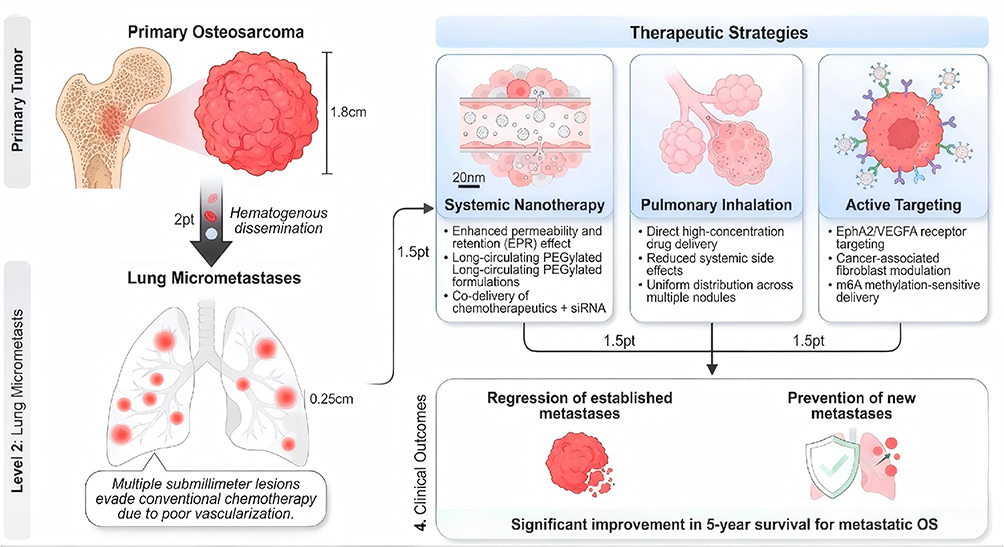 |
Figure 1 Schematic illustration of the major challenges in osteosarcoma lung metastasis and corresponding strategies enabled by nano-drug delivery systems. Abbreviation: pt, patient(s). |
Application of Nanocarrier Systems in OS
Nanotechnology has enabled the development of diverse drug delivery systems that can enhance the pharmacokinetics, biodistribution, and targeting efficiency of therapeutic agents. Table 1 summarizes the key nanocarrier platforms applied in OS, along with their physicochemical properties and representative applications. The structural features of representative nanocarrier platforms used in osteosarcoma therapy, including lipid nanoparticles, polymeric nanoparticles, carbon-based nanomaterials, exosomes, gold nanoparticles, and hydrogels, are illustrated in Figure 2.
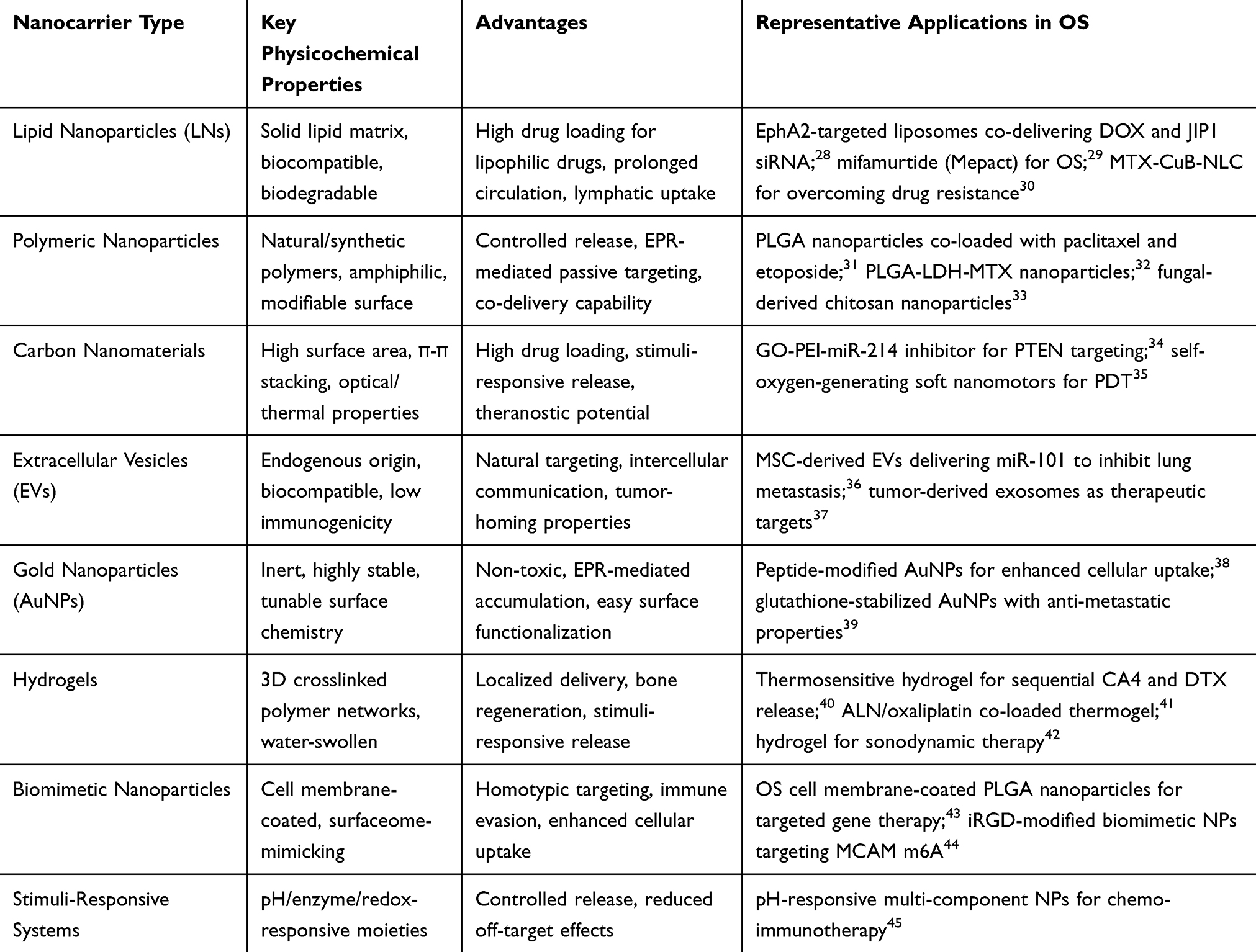 |
Table 1 Summary of Nanocarrier Platforms for Osteosarcoma Therapy, Including Their Physicochemical Properties, Advantages, and Representative Applications |
 |
Figure 2 Schematic representation of the structural features of major nanocarrier platforms applied in osteosarcoma therapy, including lipid nanoparticles, polymeric nanoparticles, carbon nanomaterials, extracellular vesicles, gold nanoparticles, hydrogels, and biomimetic systems. |
Lipid Nanoparticles (LNs)
Lipid-based nanocarriers, including liposomes and solid lipid nanoparticles (SLNs) and nanostructured lipid carriers (NLCs), are among the most extensively studied platforms for OS therapy. Their biocompatibility, ability to encapsulate both hydrophilic and hydrophobic drugs, and potential for surface functionalization make them highly versatile.28
González-Fernández et al demonstrated that edelfosine-loaded lipid nanoparticles synergistically enhanced anti-tumor activity against multidrug-resistant OS cells and significantly reduced lung metastasis in preclinical models.46 Haghiralsadat et al developed EphA2-targeted PEGylated cationic liposomes co-delivering doxorubicin and JIP1 siRNA, which restored chemosensitivity and reduced systemic toxicity.28 Notably, the liposomal immunomodulator mifamurtide (Mepact) received marketing authorization for OS in 2009 and remains the only nanomedicine approved specifically for OS.29
Recent advances in lipid-based nanocarriers include the development of MTX-CuB-NLC (methotrexate-cucurbitacin B nanostructured lipid carriers), which demonstrated enhanced cytotoxicity against methotrexate-resistant U-2 OS cells and superior tumor targeting in vivo.30 This formulation achieved particle sizes of approximately 44 nm with sustained release capabilities, representing a promising strategy to combat drug resistance in OS.
Polymers
Polymeric nanoparticles offer controlled release, high stability, and the ability to co-deliver multiple agents. Polylactic-co-glycolic acid (PLGA), polyethylene glycol (PEG), and Pluronic-based systems have been widely used.31
Wang et al developed PLGA nanoparticles co-encapsulating paclitaxel and etoposide, which exhibited controlled release and enhanced apoptosis in MG63 and Saos-2 OS cells.31 Ray et al encapsulated methotrexate in PLGA-coated layered double hydroxide nanoparticles, achieving sustained release and reduced systemic toxicity.32 Meshkini et al constructed a pH-responsive Pluronic F127-ZnHAP system loaded with methotrexate, which triggered lysosomal drug release and overcame chemoresistance.47
Polymeric nanocarriers have also been employed for nucleic acid delivery, including siRNA, miRNA, and CRISPR/Cas9 plasmids.48 For example, Liang et al used aptamer-functionalized lipopolymers to deliver CRISPR/Cas9 targeting VEGFA, inhibiting OS growth and lung metastasis.49
Emerging sources of polymeric nanomaterials include fungal-derived chitosan nanoparticles fabricated from Aspergillus niger, which demonstrated multi-target molecular interactions with IL-6, BCL2, VEGF, and NF-κB in Saos-2 cells, inducing apoptosis through oxidative stress pathways.33
Carbon Nanomaterials and Nanomotors
Graphene oxide (GO) and carbon nanotubes possess high surface areas and unique physicochemical properties suitable for drug loading and photothermal therapy. Ou et al developed GO-PEI nanosheets for delivery of miR-214 inhibitors, which suppressed OS progression via the PTEN/PI3K/Akt pathway.34 Sun et al used nano-graphene oxide for co-delivery of doxorubicin and anti-VEGF siRNA, demonstrating enhanced anti-tumor efficacy.50 Recent innovations in carbon-based nanocarriers include self-oxygen-generating soft nanomotors (SMONs-CAT-Ce6) that address the hypoxic tumor microenvironment. Tan et al demonstrated that catalase-powered soft nanomotors enhance photosensitizer penetration and accumulation in tumors while alleviating hypoxia, resulting in improved photodynamic therapy outcomes and reduced lung metastasis in 143B osteosarcoma-bearing mice.35
Extracellular Vesicles
Extracellular vesicles (EVs), including exosomes, are endogenous nanocarriers that mediate intercellular communication and exhibit natural tumor-homing properties. Zhang et al showed that EV-mediated delivery of miR-101 inhibited lung metastasis in OS by targeting BCL6.36 Raimondi et al demonstrated that OS-derived EVs contain pro-osteoclastogenic miRNAs that modulate the tumor microenvironment.51 Given their low immunogenicity and biocompatibility, EVs represent a promising platform for targeted OS therapy.52
Recent comprehensive reviews have highlighted the critical roles of tumor-derived exosomes in OS progression, immune evasion, and therapeutic resistance. Exosomes transport oncogenic proteins, immunosuppressive factors (TGF-β), miRNAs, and drug-resistance molecules, influencing key signaling cascades including Wnt/β-catenin and TGF-β pathways.37 This has led to emerging strategies targeting exosome-mediated mechanisms for OS diagnostics and therapeutics.
Gold Nanoparticles (Gold NPs)
Gold nanoparticles (AuNPs) are inert, non-toxic, and can be functionalized with targeting ligands. Mandal et al demonstrated that AuNPs modified with cell-penetrating peptides exhibited enhanced uptake in OS cells compared to unmodified nanoparticles.38 The unique optical properties of AuNPs also enable their use in photothermal therapy and imaging.53
Recent studies have revealed the anti-metastatic potential of glutathione-stabilized gold nanoparticles (Au-GSH NPs). Wilk et al demonstrated that Au-GSH NPs significantly inhibited migration and colony formation in canine osteosarcoma cells at concentrations of 200 µg/mL, while also suppressing angiogenesis in the chick embryo chorioallantoic membrane model.39 Mechanistic studies revealed increased expression of alpha-2-macroglobulin (A2M) following Au-GSH NP treatment, suggesting a novel pathway for anti-metastatic activity.
Hydrogel
Hydrogel is a porous network polymer consisting of three-dimensional crosslinked polymers that swells in water, which not only serves as a drug carrier in tumor therapy but also mimics the cellular matrix and provides mesenchymal cells with a microenvironment for growth and differentiation, so in the case of OS, hydrogel not only treats tumors but also improves bone regeneration. Due to the complexity of tumorigenesis, it is often difficult to achieve the effect of single-drug treatment. Zheng et al40 developed an injectable thermosensitive hydrogel system with co-encapsulation and sequential release of CA4 and DTX. CA4 is released first to rupture neovascularization while inhibiting the exchange of substances, and then DTX is released, which removes the cells on the surface of the tumor tissue and promotes apoptosis of cancer cells. Taking advantage of oxaliplatin (AXO), which is recognized as an anticancer drug that induces apoptosis, and alendronate (ALN), which has bone affinity as well as images of cancer cells destroying bone, Sun et al41 co-loaded these two drugs onto mPEG45-PLV 19 thermosensitive hydrogel. It was found that this system not only inhibited the progression of OS but also prevented tumor lung metastasis.
Recent advances in hydrogel-based platforms include the development of localized delivery systems for sonodynamic therapy (SDT). Lin et al developed a hydrogel co-encapsulating the nano-sonosensitizer PCN-224@MnO2@HA (PMH) and the SMAD3 inhibitor SIS3. This system enhanced reactive oxygen species production through MnO2-mediated O2 generation and GSH depletion, while SIS3 reprogrammed cancer-associated fibroblasts to reduce collagen deposition by approximately 50%, achieving 76% tumor growth inhibition in OS mouse models.42
Biomimetic and Stimuli-Responsive Nanoparticles
Biomimetic approaches represent a frontier in nanomedicine development. Dash et al developed biomimetic nanoparticles by coating PLGA nanoparticles with membranes derived from osteosarcoma cells, creating cell membrane-coated nanoparticles (CMCNPs). These nanoparticles exhibited homotypic targeting to source cancer cells while evading macrophage detection and lysosomal degradation. Mechanistic studies identified Disabled Homolog-2 (Dab2) as a key mediator of CMCNP internalization, enabling efficient cytosolic delivery of survivin-targeting siRNA with significant tumor penetration and regression activity.43
Song et al developed iRGD-modified biomimetic nanoparticles for targeted delivery of METTL3-specific inhibitors to overcome doxorubicin resistance in OS. These nanoparticles targeted the METTL3-MCAM m6A modification axis, reducing MCAM m6A modification and decreasing proliferation and invasion of doxorubicin-resistant OS cells. In vivo studies demonstrated significant inhibition of tumor growth and lung metastasis.44
Stimuli-responsive systems offer controlled release at target sites. Li et al developed a pH-responsive multi-component nanoparticle system co-delivering doxorubicin, monophosphoryl lipid A (MPLA), and a PD-1/PD-L1-targeting peptide. The optimized nanoparticles (110 nm size, 97.15% encapsulation efficiency) exhibited pH-sensitive drug release and enhanced immunogenic cell death markers. In orthotopic LM8 osteosarcoma models, the nanoparticles significantly suppressed tumor growth, promoted cytotoxic T lymphocyte infiltration, and established long-term immune memory.45
Discussion
The application of nano-drug delivery systems in osteosarcoma has advanced significantly over the past decade, driven by the need to overcome the limitations of conventional chemotherapy. Nanocarriers offer multiple advantages, including enhanced tumor accumulation via the EPR effect, active targeting through ligand functionalization, co-delivery of synergistic agents, and the ability to modulate the tumor microenvironment.12,27 As depicted in Figure 3, the therapeutic mechanisms of nano-drug delivery systems in osteosarcoma primarily involve passive targeting via the EPR effect, active targeting through ligand–receptor interactions (eg, EphA2, VEGFA, uPAR), stimuli-responsive release triggered by tumor microenvironment cues (pH, enzymes, redox), and modulation of the tumor immune microenvironment.
 |
Figure 3 Key mechanisms of nano-drug delivery systems in osteosarcoma therapy, including passive targeting (EPR effect), active targeting (ligand–receptor interactions), stimuli-responsive release (eg, pH, enzyme, redox), and tumor microenvironment modulation. |
Despite these promising preclinical advances, clinical translation of nanomedicines for OS remains limited. Several key challenges must be addressed:
First, the EPR effect—which underpins passive targeting—is highly variable in human tumors and may be insufficient for achieving therapeutic concentrations in metastatic lesions.54 Second, manufacturing complexities and batch-to-batch variability pose significant regulatory and economic hurdles.10 Third, the pediatric population presents unique considerations, including differences in organ maturation, drug metabolism, and the potential for long-term toxicity affecting growth and development.10 Currently, pediatric cancer patients are often treated with nanomedicines developed for adults without dedicated pediatric trials, highlighting a critical gap in drug development.10 Additionally, biosafety, ethical, and regulatory challenges remain to be addressed before widespread clinical application.14
To address these challenges, several future directions warrant exploration:
Active targeting strategies using ligands such as peptides, aptamers, or antibodies against OS-specific markers (eg, EphA2, VEGFA, uPAR) can enhance selectivity and reduce off-target effects.28,49 Stimuli-responsive nanocarriers that release payloads in response to pH, enzymes, or redox gradients within the tumor microenvironment offer the potential for controlled delivery.55
Biomimetic approaches, including cell membrane-coated nanoparticles and engineered extracellular vesicles, leverage natural homing mechanisms to improve targeting and reduce immunogenicity.52,56 These systems can also be designed to evade clearance by the reticuloendothelial system and enhance accumulation at metastatic sites. The integration of artificial intelligence and big data platforms may further accelerate the development of intelligent nanomedicine systems tailored to individual patient needs.14
For lung metastasis, inhalation-based delivery of nanomedicines represents an attractive strategy. Inhaled nanoparticles can achieve high local concentrations in the lungs while minimizing systemic exposure, potentially improving efficacy and reducing toxicity.57 Preclinical studies and early-phase clinical trials of inhaled lipid cisplatin have shown feasibility in OS patients with pulmonary metastases, supporting further investigation.58
Conclusions
In conclusion, nano-drug delivery systems hold substantial promise for improving the treatment of osteosarcoma, particularly in the context of lung metastasis and chemoresistance. The continued development of intelligent, biomimetic, and stimuli-responsive nanocarriers, combined with advances in understanding OS biology and the tumor microenvironment, offers hope for more effective and durable treatments. Ongoing efforts to refine targeting strategies, develop multifunctional platforms, and advance pediatric-focused clinical trials will be essential to translate these innovations into meaningful improvements in patient outcomes.
Disclosure
Siyu Jia, Boya Gong and Haidan Chen contributed equally to this work and should be considered co-first authors. The authors report no conflicts of interest in this work.
References
1. Whelan JS, Davis LE. Osteosarcoma, chondrosarcoma, and chordoma. J Clin Oncol. 2018;36(2):188–10. doi:10.1200/JCO.2017.75.1743
2. Mirabello L, Troisi RJ, Savage SA. Osteosarcoma incidence and survival rates from 1973 to 2004: data from the surveillance, epidemiology, and end results program. Cancer. 2009;115(7):1531–1543. PMID: 19197972; PMCID: PMC2813207. doi:10.1002/cncr.24121
3. Gianferante DM, Mirabello L, Savage SA. Germline and somatic genetics of osteosarcoma - connecting aetiology, biology and therapy. Nat Rev Endocrinol. 2017;13(8):480–491. PMID: 28338660. doi:10.1038/nrendo.2017.16
4. Wang Y, Zhang H, Yao P, Teng S. Linking environmental hazards to osteosarcoma development: a comprehensive review. Cancer Manag Res. 2025;17:1725–1739. PMID: 40861075; PMCID: PMC12377480. doi:10.2147/CMAR.S542371
5. Moukengue B, Lallier M, Marchandet L, et al. Origin and therapies of osteosarcoma. Cancers. 2022;14(14):3503. PMID: 35884563; PMCID: PMC9322921. doi:10.3390/cancers14143503
6. Miller KD, Fidler-Benaoudia M, Keegan TH, Hipp HS, Jemal A, Siegel RL. Cancer statistics for adolescents and young adults, 2020. CA Cancer J Clin. 2020;70(6):443–459. PMID: 32940362. doi:10.3322/caac.21637
7. Hagleitner MM, de Bont ES, Te Loo DM. Survival trends and long-term toxicity in pediatric patients with osteosarcoma. Sarcoma. 2012;2012:636405.
8. Luetke A, Meyers PA, Lewis I, Juergens H. Osteosarcoma treatment - where do we stand? A state of the art review. Cancer Treat Rev. 2014;40(4):523–532. PMID: 24345772. doi:10.1016/j.ctrv.2013.11.006
9. Bielack SS, Hecker-Nolting S, Blattmann C, Kager L. Advances in the management of osteosarcoma. F1000Res. 2016;5:2767. PMID: 27990273; PMCID: PMC5130082. doi:10.12688/f1000research.9465.1
10. Rodríguez-Nogales C, González-Fernández Y, Aldaz A, Couvreur P, Blanco-Prieto MJ. Nanomedicines for pediatric cancers. ACS Nano. 2018;12(8):7482–7496.
11. Yu W, Wang Y, Zhu J, et al. Autophagy inhibitor enhance ZnPc/BSA nanoparticle induced photodynamic therapy by suppressing PD-L1 expression in osteosarcoma immunotherapy. Biomaterials. 2019;192:128–139.
12. Pereira-Silva M, Alvarez-Lorenzo C, Concheiro A, Santos AC, Veiga F, Figueiras A. Nanomedicine in osteosarcoma therapy: micelleplexes for delivery of nucleic acids and drugs toward osteosarcoma-targeted therapies. Eur J Pharm Biopharm. 2020;148:88–106. PMID: 31958514. doi:10.1016/j.ejpb.2019.10.013
13. González-Fernández Y, Imbuluzqueta E, Zalacain M, Mollinedo F, Patiño-García A, Blanco-Prieto MJ. Doxorubicin and edelfosine lipid nanoparticles are effective acting synergistically against drug-resistant osteosarcoma cancer cells. Cancer Lett. 2017;388:262–268. PMID: 27998763. doi:10.1016/j.canlet.2016.12.012
14. Cai J, Yang H, He Z, Wu C. Intelligent nanomedicine systems utilizing diverse nanoparticles for osteosarcoma therapy: a review. Int J Nanomed. 2025;20:14115–14130. PMID: 41341865; PMCID: PMC12669381. doi:10.2147/IJN.S560865
15. Meijer AJM, Diepstraten FA, Ansari M, et al. Use of sodium thiosulfate as an otoprotectant in patients with cancer treated with platinum compounds: a review of the literature. J Clin Oncol. 2024;42(18):2219–2232. PMID: 38648563; PMCID: PMC11191063. doi:10.1200/JCO.23.02353
16. Mancilla TR, Iskra B, Aune GJ. Doxorubicin-induced cardiomyopathy in children. Compr Physiol. 2019;9(3):905–931. PMID: 31187890; PMCID: PMC7000168. doi:10.1002/cphy.c180017
17. Ahmed G, Zamzam M, Kamel A, et al. Effect of timing of pulmonary metastasis occurrence on the outcome of metastasectomy in osteosarcoma patients. J Pediatr Surg. 2019;54(4):775–779. PMID: 30005831. doi:10.1016/j.jpedsurg.2018.06.019
18. Behjati S, Tarpey PS, Haase K, et al. Recurrent mutation of IGF signalling genes and distinct patterns of genomic rearrangement in osteosarcoma. Nat Commun. 2017;8:15936. PMID: 28643781; PMCID: PMC5490007. doi:10.1038/ncomms15936
19. Sayles LC, Breese MR, Koehne AL, et al. Genome-informed targeted therapy for osteosarcoma. Cancer Discov. 2019;9(1):46–63. PMID: 30266815; PMCID: PMC7134333. doi:10.1158/2159-8290.CD-17-1152
20. Caswell DR, Swanton C. The role of tumour heterogeneity and clonal cooperativity in metastasis, immune evasion and clinical outcome. BMC Med. 2017;15(1):133. PMID: 28716075; PMCID: PMC5514532. doi:10.1186/s12916-017-0900-y
21. Zhang Y, Jiang S, Lv J, Feng W, Yu Y, Zhao H. Osteosarcoma immune microenvironment: cellular struggle and novel therapeutic insights. Front Immunol. 2025;16:1584450. PMID: 40534850; PMCID: PMC12174160. doi:10.3389/fimmu.2025.1584450
22. Yu S, Yao X. Advances on immunotherapy for osteosarcoma. Mol Cancer. 2024;23(1):192. PMID: 39245737; PMCID: PMC11382402. doi:10.1186/s12943-024-02105-9
23. Anderson RL, Balasas T, Callaghan J, et al; Cancer Therapeutics CRC Australia Metastasis Working Group. A framework for the development of effective anti-metastatic agents. Nat Rev Clin Oncol. 2019;16(3):185–204. PMID: 30514977; PMCID: PMC7136167. doi:10.1038/s41571-018-0134-8
24. Landuzzi L, Manara MC, Lollini PL, Scotlandi K. Patient derived xenografts for genome-driven therapy of osteosarcoma. Cells. 2021;10(2):416. PMID: 33671173; PMCID: PMC7922432. doi:10.3390/cells10020416
25. Fan TM, Roberts RD, Lizardo MM. Understanding and modeling metastasis biology to improve therapeutic strategies for combating osteosarcoma progression. Front Oncol. 2020;10:13. PMID: 32082995; PMCID: PMC7006476. doi:10.3389/fonc.2020.00013
26. Steeg PS. Targeting metastasis. Nat Rev Cancer. 2016;16(4):201–218. PMID: 27009393; PMCID: PMC7055530. doi:10.1038/nrc.2016.25
27. Giacchi L, Pucci E, Rucci N. From bench to bedside: advancements in precision oncology and drug discovery for osteosarcoma. Cancers. 2026;18(4):561. PMID: 41749815; PMCID: PMC12939273. doi:10.3390/cancers18040561
28. Haghiralsadat F, Amoabediny G, Naderinezhad S, et al. EphA2 targeted doxorubicin-nanoliposomes for osteosarcoma treatment. Pharm Res. 2017;34(12):2891–2900. PMID: 29110283. doi:10.1007/s11095-017-2272-6
29. Kager L, Pötschger U, Bielack S. Review of mifamurtide in the treatment of patients with osteosarcoma. Ther Clin Risk Manag. 2010;6:279–286. PMID: 20596505; PMCID: PMC2893760. doi:10.2147/tcrm.s5688
30. Li H, Bao T, Huang X, et al. Overcoming drug resistance in osteosarcoma with MTX-CuB-NLC: an in vitro and in vivo study. Eur J Pharm Biopharm. 2025;214:114779. PMID: 40490044. doi:10.1016/j.ejpb.2025.114779
31. Wang B, Yu XC, Xu SF, Xu M. Paclitaxel and etoposide co-loaded polymeric nanoparticles for the effective combination therapy against human osteosarcoma. J Nanobiotechnology. 2015;13:22. PMID: 25880868; PMCID: PMC4377179. doi:10.1186/s12951-015-0086-4
32. Ray S, Saha S, Sa B, Chakraborty J. In vivo pharmacological evaluation and efficacy study of methotrexate-encapsulated polymer-coated layered double hydroxide nanoparticles for possible application in the treatment of osteosarcoma. Drug Deliv Transl Res. 2017;7(2):259–275. PMID: 28050892. doi:10.1007/s13346-016-0351-6
33. Varshan GSA, Namasivayam SKR, Sivasuriyan KS, Sowmya R. Fungal derived chitosan nanoparticles fabricated from Aspergillus Niger induces multi target molecular interaction on osteosarcoma (Saos-2 cells). Biochem Biophys Res Commun. 2025;786:152730. PMID: 41056880. doi:10.1016/j.bbrc.2025.152730
34. Ou L, Lin H, Song Y, et al. Efficient miRNA inhibitor with GO-PEI nanosheets for osteosarcoma suppression by targeting PTEN [Retraction]. Int J Nanomed. 2023;18:3283–3284.
35. Tan X, Wang Y, Yuan Y, et al. A catalase-powered self-oxygen-generating soft nanomotor for photodynamic therapy of osteosarcoma. Mater Today Bio. 2025;32:101796. PMID: 40453819; PMCID: PMC12124666. doi:10.1016/j.mtbio.2025.101796
36. Zhang K, Dong C, Chen M, et al. Extracellular vesicle-mediated delivery of miR-101 inhibits lung metastasis in osteosarcoma. Theranostics. 2020;10(1):411–425. PMID: 31903129; PMCID: PMC6929625. doi:10.7150/thno.33482
37. Wang J, Shi K. Role of tumor-derived exosomes and immune cells in osteosarcoma progression and targeted therapy. Front Immunol. 2025;16:1658358. PMID: 41383602; PMCID: PMC12689977. doi:10.3389/fimmu.2025.1658358
38. Mandal D, Maran A, Yaszemski MJ, Bolander ME, Sarkar G. Cellular uptake of gold nanoparticles directly cross-linked with carrier peptides by osteosarcoma cells. J Mater Sci Mater Med. 2009;20(1):347–350. PMID: 18807262; PMCID: PMC2824438. doi:10.1007/s10856-008-3588-x
39. Wilk SS, Kukier KI, Michałowski AM, et al. The anti-metastatic properties of glutathione-stabilized gold nanoparticles-a preliminary study on canine osteosarcoma cell lines. Int J Mol Sci. 2025;26(13):6102. PMID: 40649877; PMCID: PMC12249675. doi:10.3390/ijms26136102
40. Zheng Y, Cheng Y, Chen J, et al. Injectable hydrogel-microsphere construct with sequential degradation for locally synergistic chemotherapy. ACS Appl Mater Interfaces. 2017;9(4):3487–3496. PMID: 28067493. doi:10.1021/acsami.6b15245
41. Sun Y, Li K, Li C, Zhang Y, Zhao D. Thermogel delivers oxaliplatin and alendronate in situ for synergistic osteosarcoma therapy. Front Bioeng Biotechnol. 2020;8:573962. PMID: 33042974; PMCID: PMC7523411. doi:10.3389/fbioe.2020.573962
42. Lin S, Liu H, Lv L, et al. Hydrogel delivering antifibrotic agent and nano-sonosensitizer enhances efficacy of sonodynamic therapy in osteosarcoma treatment. Bioact Mater. 2025;56:77–94. PMID: 41141582; PMCID: PMC12550586. doi:10.1016/j.bioactmat.2025.10.001
43. Dash P, Das K, Dash M. Mimicking the osteosarcoma surfaceome on nanoparticles for targeted gene therapy. Biomater Sci. 2025;13(21):6179–6201. PMID: 41021291. doi:10.1039/d5bm01104c
44. Song D, Liu Q, Zhang D, et al. Enhancing doxorubicin sensitivity in osteosarcoma via iRGD-modified biomimetic nanoparticles targeting MCAM m6A modification. J Transl Med. 2025;23(1):804. PMID: 40676653; PMCID: PMC12272969. doi:10.1186/s12967-025-06735-5
45. Li D, Li Y, Cang J, et al. Synergistic chemo-immunotherapy for osteosarcoma via a pH-responsive multi-component nanoparticle system. Front Pharmacol. 2025;16:1584245. PMID: 40264674; PMCID: PMC12011790. doi:10.3389/fphar.2025.1584245
46. González-Fernández Y, Brown HK, Patiño-García A, Heymann D, Blanco-Prieto MJ. Oral administration of edelfosine encapsulated lipid nanoparticles causes regression of lung metastases in pre-clinical models of osteosarcoma. Cancer Lett. 2018;430:193–200. PMID: 29802930. doi:10.1016/j.canlet.2018.05.030
47. Meshkini A, Oveisi H. Methotrexate-F127 conjugated mesoporous zinc hydroxyapatite as an efficient drug delivery system for overcoming chemotherapy resistance in osteosarcoma cells. Colloids Surf B Biointerfaces. 2017;158:319–330. PMID: 28711857. doi:10.1016/j.colsurfb.2017.07.006
48. Kara A, Ozturk N, Esendagli G, et al. Development of novel self-assembled polymeric micelles from partially hydrolysed poly(2-ethyl-2-oxazoline)-co-PEI-b-PCL block copolymer as non-viral vectors for plasmid DNA in vitro transfection. Artif Cells Nanomed Biotechnol. 2018;46(sup3):S264–S273. PMID: 30032650. doi:10.1080/21691401.2018.1491478
49. Liang C, Li F, Wang L, et al. Tumor cell-targeted delivery of CRISPR/Cas9 by aptamer-functionalized lipopolymer for therapeutic genome editing of VEGFA in osteosarcoma. Biomaterials. 2017;147:68–85. PMID: 28938163. doi:10.1016/j.biomaterials.2017.09.015
50. Sun Q, Wang X, Cui C, Li J, Wang Y. Doxorubicin and anti-VEGF siRNA co-delivery via nano-graphene oxide for enhanced cancer therapy in vitro and in vivo. Int J Nanomed. 2018;13:3713–3728. PMID: 29983564; PMCID: PMC6028351. doi:10.2147/IJN.S162939
51. Raimondi L, De Luca A, Gallo A, et al. Osteosarcoma cell-derived exosomes affect tumor microenvironment by specific packaging of microRNAs. Carcinogenesis. 2020;41(5):666–677. PMID: 31294446. doi:10.1093/carcin/bgz130
52. Xia Y, Rao L, Yao H, Wang Z, Ning P, Chen X. Engineering macrophages for cancer immunotherapy and drug delivery. Adv Mater. 2020;32(40):e2002054. PMID: 32856350. doi:10.1002/adma.202002054
53. Singh P, Pandit S, Mokkapati VRSS, Garg A, Ravikumar V, Mijakovic I. Gold Nanoparticles in Diagnostics and Therapeutics for Human Cancer. Int J Mol Sci. 2018;19(7):1979. PMID: 29986450; PMCID: PMC6073740. doi:10.3390/ijms19071979
54. Park J, Choi Y, Chang H, Um W, Ryu JH, Kwon IC. Alliance with EPR effect: combined strategies to improve the EPR effect in the tumor microenvironment. Theranostics. 2019;9(26):8073–8090. PMID: 31754382; PMCID: PMC6857053. doi:10.7150/thno.37198
55. Yin F, Wang Z, Jiang Y, et al. Reduction-responsive polypeptide nanomedicines significantly inhibit progression of orthotopic osteosarcoma. Nanomedicine. 2020;23:102085. PMID: 31442580. doi:10.1016/j.nano.2019.102085
56. Rao L, Bu LL, Cai B, et al. Cancer cell membrane-coated upconversion nanoprobes for highly specific tumor imaging. Adv Mater. 2016;28(18):3460–3466. PMID: 26970518. doi:10.1002/adma.201506086
57. Chou AJ, Gupta R, Bell MD, Riewe KO, Meyers PA, Gorlick R. Inhaled lipid cisplatin (ILC) in the treatment of patients with relapsed/progressive osteosarcoma metastatic to the lung. Pediatr Blood Cancer. 2013;60(4):580–586. PMID: 23255417. doi:10.1002/pbc.24438
58. Oh F, Todhunter D, Taras E, Vallera DA, Borgatti A. Targeting EGFR and uPAR on human rhabdomyosarcoma, osteosarcoma, and ovarian adenocarcinoma with a bispecific ligand-directed toxin. Clin Pharmacol. 2018;10:113–121. PMID: 30288129; PMCID: PMC6163021. doi:10.2147/CPAA.S160262
 © 2026 The Author(s). This work is published and licensed by Dove Medical Press Limited. The
full terms of this license are available at https://www.dovepress.com/terms
and incorporate the Creative Commons Attribution
- Non Commercial (unported, 4.0) License.
By accessing the work you hereby accept the Terms. Non-commercial uses of the work are permitted
without any further permission from Dove Medical Press Limited, provided the work is properly
attributed. For permission for commercial use of this work, please see paragraphs 4.2 and 5 of our Terms.
© 2026 The Author(s). This work is published and licensed by Dove Medical Press Limited. The
full terms of this license are available at https://www.dovepress.com/terms
and incorporate the Creative Commons Attribution
- Non Commercial (unported, 4.0) License.
By accessing the work you hereby accept the Terms. Non-commercial uses of the work are permitted
without any further permission from Dove Medical Press Limited, provided the work is properly
attributed. For permission for commercial use of this work, please see paragraphs 4.2 and 5 of our Terms.