
Back to Journals » International Journal of Women's Health » Volume 18
A Qualitative Study on Pregnant Women’s Perceptions and Needs for Developing a WeChat Mini-Program for Physical Activity Management During Pregnancy
Authors Li X, Liang Y, Huang J, Cai S
Received 11 November 2025
Accepted for publication 24 January 2026
Published 9 March 2026 Volume 2026:18 580560
DOI https://doi.org/10.2147/IJWH.S580560
Checked for plagiarism Yes
Review by Single anonymous peer review
Peer reviewer comments 2
Editor who approved publication: Dr Vinay Kumar
XiaoYun Li,1,2,* YuZhen Liang,1,* JinXia Huang,3 Shu Cai1
1School of Nursing, Guangdong Pharmaceutical University, Guangzhou, Guangdong, People’s Republic of China; 2Department of Nursing, School of Medicine, The Sixth Affiliated Hospital of South China University of Technology (Nanhai District People’s Hospital of Foshan), Foshan, Guangdong, People’s Republic of China; 3Department of Obstetrics, Yunfu People’s Hospital, Yunfu, Guangdong, People’s Republic of China
*These authors contributed equally to this work
Correspondence: Shu Cai, School of Nursing, Guangdong Pharmaceutical University, Guangzhou, Guangdong, People’s Republic of China, Tel +86-020-34055937, Email [email protected]
Purpose: Physical activity is crucial for the health of both the mother and the baby, but it is often underutilized due to safety concerns, insufficient guidance, and the lack of user-friendly platforms. This study explored pregnant women’s perceptions and needs regarding mobile health platforms for physical activity management to guide the development of a needs-oriented intelligent management platform.
Patients and Methods: A descriptive qualitative study was conducted with 37 pregnant women recruited from the obstetric outpatient department. Semi-structured interviews were conducted, and data were analyzed using content analysis. This study was reported following SRQR guidelines.
Results: Four key themes emerged: physical and mental changes during pregnancy, perceptions and concerns about exercise, needs for exercise guidance, and requirements for mobile health platforms.
Conclusion: Pregnant women are receptive to mobile health platforms for physical activity management. Developers and healthcare providers should focus on meeting their actual needs through a comprehensive, safe, and personalized tool to support physical activity during pregnancy.
Keywords: pregnant women, physical activity, needs assessment, qualitative research, intelligent management platform
Introduction
Physical activity is an important part of prenatal care. Regular exercise during pregnancy helps improve the cardiopulmonary function of pregnant women, control weight, relieve low back pain, and has a positive impact on the health of both the mother and the baby.1 The American College of Obstetricians and Gynecologists (ACOG) recommends that, except for a few contraindications, pregnant women should engage in at least 150 minutes of moderate - intensity exercise per week.2,3 A survey of 3579 urban pregnant women in China showed that the physical activity levels of Chinese pregnant women were generally low, with more than 40% of pregnant women having low physical activity levels in each trimester.4 The reasons for the low exercise compliance of pregnant women include insufficient awareness of the safety and benefits of exercise and the lack of personalized guidance.5 With the popularization of mobile Internet and smart devices, app - based health management tools provide new ideas for prenatal care. WeChat is a widely used social messaging app in China, with over 1.3 billion monthly active users.6 It offers a variety of features, including messaging, voice and video calls, news feeds, and mini-programs. WeChat mini-programs are sub-applications within the WeChat ecosystem that provide additional functionality and services.7 Unlike standalone applications, WeChat mini programs eliminate the need for additional downloads and achieve seamless access to exercise guidance, peer support, and personalized monitoring. Pregnant women often use WeChat to seek health information and support from peers and healthcare providers.8 Studies have shown that pregnant women in China use wechat frequently, with more than half of pregnant women using wechat mini-programs to look up pregnancy, feeding or health knowledge.9–11 However, the functions of existing domestic prenatal care intelligent platforms are relatively simple, mainly focusing on prenatal knowledge push and life records, and there is still room for improvement in personalized exercise management services.12 In recent years, information technology and big data analysis methods have been widely used in the healthcare field, providing new opportunities for the precise management of physical activity during pregnancy.13 This study aimed to explore pregnant women’s perceptions and needs regarding the development of a WeChat mini-program for physical activity management during pregnancy. WeChat mini-program was chosen as the delivery channel due to its wide reach and rich features that can facilitate health information seeking and support. However, current prenatal care mini-programs in China primarily focus on knowledge dissemination and life logging, lacking specialized functions for personalized exercise management,14 highlighting an urgent need to develop a targeted platform.
This study aimed to conduct in-depth interviews with pregnant women using qualitative research methods to explore their perceptions and needs regarding the development of a WeChat mini-program for physical activity management during pregnancy, so as to provide a reference for the development of a needs-oriented intelligent management platform for physical activity during pregnancy, further optimize the management model of physical activity during pregnancy, and promote the health of both the mother and the baby.
Materials and Methods
Study Participants
From May 2024 to September 2024, pregnant women attending the obstetric outpatient clinic of a tertiary hospital were recruited as study participants. A purposive sampling strategy was adopted to include women of varying ages, occupations, parity, and gestational ages to ensure participant representativeness and diversity.
Inclusion criteria: Participants were required to have Mandarin listening, speaking, reading, and writing skills, along with at least a high school education, to ensure accurate comprehension and expression of research-related content. Additional inclusion criteria included the absence of cognitive impairment or mental illness and the ability to cooperate in completing interviews. Exclusion criteria: Pregnant women who were diagnosed with other severe complications prior to pregnancy.
The sample size for this study was determined through a saturation-based approach. Following the method for assessing saturation in qualitative research,15 data collection ceased when no new themes or information emerged from subsequent interviews. After iterative interviews and data analysis, saturation was reached, and recruitment concluded with a final sample of 37 pregnant women. The interviews were conducted by two trained female researchers with more than 5 years of qualitative research experience in maternal care. The two researchers were systematically trained in semi-structured interview skills and in the coding of qualitative data. To minimize interviewer bias, a pilot interview was conducted prior to the formal study to unify the interviewers’ understanding of the present study and ensure consistency in the interview process.
Among the 37 participants, ages ranged from 22 to 36 years (mean age: 30.13 ± 2.78), and gestational ages spanned 4 to 38 weeks. Regarding education levels, three participants had secondary or high school education, seven had associate degrees, and 27 had bachelor’s degrees or higher. The study was approved by the Ethics Committee of Nanhai District People’s Hospital (Approval No. NYKY-2024-130-01), and this study complied with the Declaration of Helsinki. All participants provided written informed consent after being fully informed of the study’s purpose, procedures, potential risks, and benefits. They were anonymized using codes (P1, P2…Pn).
Methods
Development of the Interview Guide
A semi-structured interview guide was specifically developed for this qualitative research. This guide referred to a comprehensive review of relevant literature on physical activity during pregnancy in Chinese and English databases. The Chinese databases searched included CNKI, Wanfang Data, VIP Database, and Chinese Biomedical Literature Database. The English databases searched were PubMed, Web of Science, and CINAHL. The search time was from January 1, 2014, to October 1, 2024, and the keywords used were “pregnant women”, “physical activity/exercise”, “informatization/intelligence/internet” in Chinese and “pregnant women”, “physical activity/exercise”, “mHealth/eHealth” in English. The initial draft of the interview guide was further improved through discussions within the research team and pre-interviews.
Theoretical Basis
This study drew upon the Health Belief Model (HBM) and the Social Cognitive Theory (SCT) to guide the design of the interview framework and data analysis. The Health Belief Model posits that an individual’s adoption of a health-related behavior depends on their perception of disease susceptibility and severity, as well as their evaluation of the benefits and barriers associated with the behavior.16 When designing the interview questions, we included inquiries about pregnant women’s awareness and attitudes toward physical activity during pregnancy to assess their perceived benefits of exercise, perceived risks of inactivity, and challenges in accessing and adhering to prenatal exercise guidance. These elements helped identify factors influencing their engagement in physical activity.
The Social Cognitive Theory emphasizes the dynamic interplay between personal factors (eg, cognition, attitudes), behavior, and environmental influences.17 In developing the interview framework, we incorporated questions about societal and environmental factors, such as family support and healthcare settings, to examine their impact on pregnant women’s physical activity behaviors. Additionally, we explored participants’ perceptions of existing prenatal health management platforms and their expectations for new platform features, as these subjective cognitions and attitudes may shape their willingness and behavior toward using such tools.
During data analysis, the HBM provided a theoretical lens to examine pregnant women’s perceptions and influencing factors regarding prenatal physical activity, while the SCT helped analyze how their subjective cognitions, attitudes, and environmental contexts affected their behavioral intentions toward adopting smart platforms. By integrating these two theories, we gained a comprehensive and in-depth understanding of the key factors influencing pregnant women’s use of prenatal physical activity management platforms.
The primary objective of this study was to explore pregnant women’s awareness and needs regarding smart platforms for prenatal physical activity management, thereby offering insights for future platform development. While the HBM and SCT primarily guided interview design and data analysis, their principles could be further incorporated into the functional design and optimization of such platforms in subsequent development and application phases.
The final semi-structured interview guide included the following key questions: What are your current perceptions and attitudes towards physical activity during pregnancy? How do you usually obtain relevant knowledge and information? What difficulties or challenges do you face in obtaining and following prenatal exercise guidance? What kind of support do you hope to receive? What do you think are the deficiencies of the existing prenatal health management apps in terms of physical activity management? If a mobile health management platform for physical activity management during pregnancy were to be developed, what functions do you think would be essential? In what way do you hope the relevant knowledge and guidance will be presented?
Data Collection
This study employed a descriptive qualitative research approach. Prior to formal interviews, two pilot interviews were conducted to test the feasibility and comprehensiveness of the interview guide. Before each interview, the researchers first explained the study’s purpose and content to the pregnant participants, emphasizing data confidentiality and anonymity. Interviews commenced only after obtaining written informed consent. Interviews were held in quiet, undisturbed settings—either private consultation rooms or health education rooms in the obstetric outpatient department. Two trained researchers conducted face-to-face interviews (one leading the discussion, the other recording notes). The entire process was audio-recorded, with detailed documentation of nonverbal cues such as facial expressions, tone of voice, and gestures. To prevent participant fatigue, interviews were limited to 30–45 minutes. Researchers encouraged in-depth expression of genuine perspectives through techniques like paraphrasing and follow-up questions.
Data Analysis
Upon completing the interviews, researchers produced verbatim transcripts within 24 hours, which were then cross-checked by another researcher for accuracy and completeness. The transcripts were saved as Word documents and imported into NVivo 12.0 software. Through content analysis, the data were systematically examined sentence-by-sentence to extract and synthesize key themes. The specific analytical steps were as follows:18,19
- Data Familiarization: Repeatedly reviewing interview transcripts to develop a comprehensive understanding of the data.
- Identifying Coding Units: Segmenting transcripts into discrete coding units (eg, phrases, sentences, or paragraphs).
- Open Coding: Conducting preliminary coding for each unit to capture its core meaning.
- Category Development: Grouping similar codes into higher-level categories.
- Theme Generation: Further analyzing relationships between categories to derive overarching themes addressing the research questions.
- Theme Validation: Verifying the alignment between themes and raw data, with refinements made as needed. To ensure analytical rigor, two researchers independently coded the data and subsequently compared their results. Discrepancies were resolved through discussion, with a third researcher consulted if necessary until consensus was achieved.20
Results
Through thematic analysis of interview data from 37 pregnant women, four main themes and ten sub-themes were identified. The four themes are: (1) physical and psychological changes and needs during pregnancy; (2) perceptions and concerns about exercise during pregnancy; (3) needs for exercise guidance during pregnancy; (4) functional concepts for a pregnancy physical activity management platform. Table 1 presents the sub-themes per trimester for each main theme. The next subsection provides detailed elaboration of each theme, supported by example quotes from the participants.
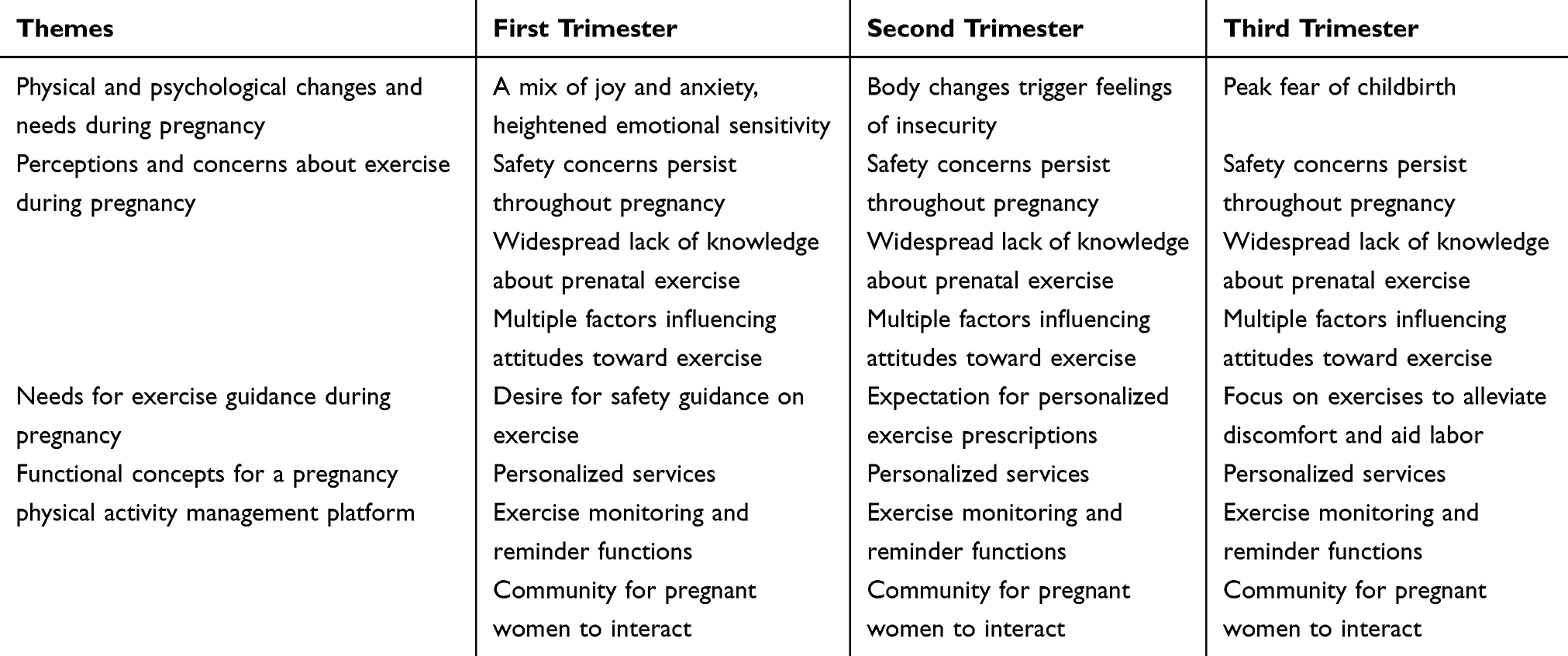 |
Table 1 Sub-Themes per Trimester for Each Main Theme |
Detailed Elaboration of Each Theme
The next subsection provides detailed elaboration of each theme, supported by example quotes from the participants.
Theme 1: Physical and Psychological Changes and Needs During Pregnancy
The first trimester is a critical phase of significant physical and emotional changes for pregnant women. Most interviewees reported mixed feelings of happiness and worry upon learning of their pregnancy—joy for the new life but anxiety about the unknowns of pregnancy and fetal health. Early symptoms like nausea and fatigue also caused inconvenience, making emotions more volatile. P1 said, “In early pregnancy, my mood swings were intense. If something upset me, I’d lock myself in the room and cry”.
As pregnancy progressed, women gradually adapted to bodily changes, and discomfort lessened. However, body image concerns often led to low self-esteem. P2 shared, “Looking in the mirror, I felt deformed and bloated. I worried about attracting strange looks outside and really needed comfort and encouragement”.
In late pregnancy, fear of labor peaked, compounded by mobility limitations and poor sleep. P3 said, “As my due date approached, I felt uneasy and terrified of the pain of childbirth”.
Theme 2: Perceptions and Concerns About Exercise Among Pregnant Women
Worries about exercise safety were pervasive but varied by trimester. In the first trimester, many women feared vigorous exercise might harm fetal stability. P3 mentioned, “I heard intense exercise could cause unstable fetal heart rates, so I never dared try”. P5 said, “I avoided strenuous activity, worried it might affect fetal nutrition”. Knowledge gaps were common, as P9 stated, “I knew exercise was good but had no idea what types or durations were safe”.
In the second trimester, some concerns eased, but caution remained. P15 shared, “As my body adjusted, my fear lessened”. However, P18 expressed, “I still worried exercise might trigger contractions, so I avoided intensity”. Some sought knowledge but felt inadequately informed. P17 said, “I heard yoga and swimming were safe but didn’t know specifics like intensity”.
In the third trimester, safety fears intensified. P28 mentioned, “I grew more cautious, afraid exercise might induce preterm labor”. P32 stated, “With limited mobility and safety concerns, I barely exercised”. Knowledge gaps persisted, with P29 saying, “Near my due date, I felt clueless—afraid even moderate movements might cause issues”.
Women’s concerns about prenatal exercise stemmed from several factors. Misconceptions about the risks associated with exercise during pregnancy were common. Many women also reported a lack of professional guidance and an absence of medical advice on safe and appropriate exercise. Some women had personal complications or prior pregnancy losses that made them more cautious about engaging in physical activity. Fragmented information sources and societal norms favoring rest over activity further contributed to their hesitancy towards prenatal exercise.
Theme 3: Needs for Exercise Guidance Among Pregnant Women
In the first trimester, women prioritized safety advice. P5 said, “I needed a doctor’s professional opinion to feel secure”. P9 expressed, “I wanted clear dos and don’ts, not generalities”.
In the second trimester, women sought tailored plans. P18 shared, “I wanted advice matching my current state”. P22 said, “I needed a custom plan—type, frequency, duration”. Some craved variety, with P7 stating, “Prenatal classes were repetitive. I wanted more options”.
In the third trimester, needs shifted to safety and labor preparation. P31 mentioned, “I needed to know which late-term exercises were safe”. P32 said, “I wanted moves to ease back pain and swelling”. P28 expressed, “I needed guidance on perineal massage and Kegels for labor”.
Theme 4: Functional Concepts for a Pregnancy Physical Activity Management Platform
Women wanted adaptive guidance from the platform. P7 said, “The platform should recommend safe exercises based on my trimester and condition”. P19 expressed, “As my body changes, the plan should update dynamically”. P32 shared, “I’d love late-pregnancy suggestions, ideally tailored to my symptoms”.
Tracking and reminders were deemed essential functions. P14 said, “Daily reminders would help me build a routine”. P34 stated, “It should log my workouts, track intensity/calories, and suggest adjustments”.
A peer support space was also desired. P9 shared, “I’d love to share tips and motivation with other moms-to-be”. P17 said, “A forum to discuss exercises would let me check if I’m doing things right”.
The focus evolves from “managing pregnancy uncertainties and emotional fluctuations” (first trimester) to “addressing body image insecurity” (second trimester), and finally to “alleviating physical discomfort and coping with fear of childbirth” (third trimesters). Exercise safety concerns persist but shift focus: from “protecting fetal stability” (early pregnancy) to “avoiding overexertion/contractions” (mid-pregnancy) and “preventing preterm labor” (late pregnancy). This transitions from “basic safety precautions” (early pregnancy) to “personalized exercise plans” (mid-pregnancy) and “discomfort relief and birth preparation exercises” (late pregnancy).
Discussion
The findings of this study regarding exercise barriers among pregnant women align with Ahmadi’s review,21 both confirming that safety concerns are the core factor hindering exercise during pregnancy. The high acceptance of digital health platforms corresponds with Goetz’s conclusion that pregnant women widely recognize the role of digital tools in supplementing traditional care.22 Compared to Kraschnewski’s research,23 this study further refines the differing needs across pregnancy stages, providing more precise guidance for phased platform functionality design. Unlike Hayman’s content analysis of pregnancy exercise apps,13 this research focuses specifically on WeChat Mini Programs. By integrating Chinese pregnant women’s usage habits, the proposed functional requirements demonstrate greater localized applicability.24
Analysis of Pregnant Women’s Acceptance of Intelligent Pregnancy Physical Activity Management Platforms
This study found that pregnant women generally hold a positive attitude toward intelligent platforms, believing such platforms can compensate for the shortcomings of traditional prenatal care by providing personalized exercise guidance. This finding aligns with previous research,25,26 but the present study further reveals the key factors influencing acceptance and their underlying mechanisms. The complex physical and psychological changes during pregnancy significantly impact platform acceptance. The mix of joy and anxiety in the first trimester, the decline in self-perception during the second trimester, and the fear of childbirth in the third trimester may all reduce motivation to use the platform. This suggests that the platform should tailor emotional support and motivational strategies to the psychological characteristics of each trimester. For example, offering anxiety management strategies in the first trimester, focusing on self-efficacy enhancement in the second trimester, and reinforcing childbirth preparation and confidence-building in the third trimester. Such precise, dynamic psychological interventions can improve both acceptance and engagement with the platform. Concerns about exercise safety are another critical factor affecting acceptance. Pregnant women’s worries about exercise risks persist throughout pregnancy, stemming from cognitive biases and a lack of professional guidance, which further undermines trust in the platform. This highlights the importance of correcting misconceptions and providing evidence-based safety knowledge to enhance acceptance. The platform should integrate authoritative prenatal exercise guidelines and offer personalized risk assessments and exercise prescriptions based on individual circumstances (eg, complications, high-risk factors) to strengthen trust and perceived safety. Additionally, incorporating real-time monitoring and intelligent alert functions can effectively address safety concerns. A lack of professional knowledge also limits willingness to use the platform. Women desire standardized, scientifically grounded exercise guidance, but existing channels often lack expertise and specificity.27 This underscores the need to integrate multidisciplinary professional resources. The platform should collaborate with experts in obstetrics, sports medicine, and nutrition to provide comprehensive, authoritative health knowledge and behavioral guidance. With credible professional endorsement, the platform is more likely to gain recognition and trust. Furthermore, expert teams can contribute to continuous content updates and optimization, ensuring alignment with the latest guidelines and research evidence to meet the growing demand for professional support.
Demand-Driven Functional Architecture of an Intelligent Pregnancy Physical Activity Management Platform
Interview findings reveal that pregnant women have diversified needs for intelligent platform functionalities, including personalized exercise plans, real-time monitoring and feedback, and social interaction features. These insights provide critical guidance for platform development.
Personalized services emerge as the core demand. Participants expect the platform to develop tailored exercise regimens by comprehensively considering gestational age, physical condition, and exercise habits, with dynamic adjustments based on changing needs. This requires advanced capabilities in data collection, analysis, and application. The platform should leverage wearable devices and mobile applications for continuous, dynamic health and behavioral data acquisition. Through machine learning algorithms and knowledge graph technology, it can construct individualized user profiles to match optimal exercise solutions.28 Embedded artificial intelligence can further refine exercise plans based on real-time monitoring data and user feedback, enhancing both precision and timeliness. Adaptive learning technology may also personalize the presentation of exercise-related knowledge according to users’ health literacy levels and learning progress, improving accessibility and practical value.
Diverse exercise resources constitute another key requirement. While women express interest in novel formats like prenatal yoga and birthing ball exercises, current channels remain limited. The platform should integrate online and offline resources by taking the following actions:
Incorporating video-on-demand and live-streaming courses to deliver varied content.
Partnering with physical fitness centers to offer subsidized or complimentary classes with closed-loop management of booking, attendance, and evaluation.
Utilizing VR/AR technologies to create immersive exercise experiences.29
Implementing intelligent resource recommendation systems to boost engagement.
Social interaction features are equally anticipated. Women desire peer support networks for experience sharing and mutual encouragement. The platform should take the following steps:
Establish dedicated forums and interest groups for knowledge exchange.
Incorporate gamification elements like real-time interaction and friendly competitions.
Employ social network analysis to recommend compatible exercise partners.
This hybrid model blending virtual communities with intelligent management can enhance motivation and compliance while pioneering new prenatal care paradigms.30
Drawing from these findings, we propose a demand-driven functional framework comprising three core components—personalized services, exercise resource integration, and social interaction—supported by data-driven and AI technologies. This architecture offers both theoretical reference and practical guidance for platform development.
Application Value and Development Directions of Intelligent Pregnancy Physical Activity Management Platforms
Information technology-driven intelligent platforms present new possibilities for managing physical activity during pregnancy. On the one hand, these platforms can transcend the temporal and spatial limitations of traditional prenatal care, providing convenient and continuous behavioral interventions to effectively enhance exercise adherence. On the other hand, the multi-dimensional, dynamic data collected by intelligent platforms offers novel approaches for precisely assessing pregnancy health risks and optimizing management decisions.
The integration of real-time monitoring data with medical big data can facilitate the construction of pregnancy risk prediction models, enabling early warning systems for pregnancy complications.31 This advancement holds promise for reducing pregnancy risks and improving maternal and neonatal outcomes. Consequently, the application value of intelligent platforms should not be underestimated, as they may serve as valuable supplements to traditional prenatal care and provide new momentum for promoting maternal and child health. However, it is important to recognize that the development of such platforms in China remains in its nascent stages, facing several challenges in practical application.
First, data security and privacy protection require urgent strengthening. Given the highly sensitive nature of pregnant women’s health data, platforms must strictly adhere to data security and ethical guidelines, implementing robust technical safeguards and management protocols to alleviate privacy concerns. Second, platform functionality and user experience need optimization. To maximize utility, platforms must thoroughly consider the actual needs and usage habits of pregnant women, delivering intuitive, user-friendly interfaces with seamless interaction. Third, the scientific validity and standardization of these platforms require further verification. Exercise guidance provided must be grounded in evidence-based medicine and aligned with authoritative guidelines. Establishing rigorous content review and update mechanisms, along with periodic evaluations of platform efficacy, are critical priorities. Looking ahead, research and practice in this field should focus on the following directions:
Enhancing interdisciplinary integration by combining expertise from sports medicine, obstetrics, and information science to provide stronger theoretical and technological foundations for platform development.
Conducting platform-based intervention studies through rigorous empirical research designs to objectively evaluate effectiveness and drive continuous improvement.12
Prioritizing user experience by employing participatory design methods to incorporate feedback from pregnant women and stakeholders, ensuring ongoing optimization of platform features.
Strengthening regulation and standardization through the establishment of management protocols and technical standards to safeguard user rights and ensure ethical operation.
Through collaborative efforts across sectors, intelligent pregnancy activity management platforms will mature, injecting new vitality into prenatal care practices. This study systematically examines acceptance factors and functional requirements through in-depth interviews, proposing a demand-driven framework to guide platform development. While these platforms show significant potential for enhancing physical activity participation and health management, challenges remain in data security, functionality, and scientific validation—necessitating coordinated action to ensure sustainable development. Future research should expand sample diversity, incorporate multi-stakeholder perspectives, and employ robust intervention studies to further refine platform effectiveness.
The innovation and contributions of this study are primarily reflected in three aspects: First, it systematically reveals the dynamic evolution of exercise needs across different stages of pregnancy, providing a novel theoretical basis for the platform’s phased personalized design. Second, by focusing on the highly popular WeChat Mini Program platform and integrating Chinese pregnant user scenarios (eg, the social attributes of WeChat, no need for additional downloads), the proposed functional design better aligns with localized needs, filling the gap in existing research targeting specific digital platforms. Third, it integrates the Health Belief Model with Social Cognitive Theory for needs analysis. This approach not only identifies surface-level needs but also delves into underlying factors like cognition, attitudes, and environment, providing theoretical support for precisely implementing platform features rather than merely listing functionalities.
Limitations
This qualitative study employed in-depth interviews to explore pregnant women’s perceptions and needs regarding an intelligent platform for physical activity management during pregnancy, providing valuable insights for platform development. However, several limitations should be acknowledged.
The study used purposive sampling, recruiting 37 pregnant women from the obstetrics clinic of a tertiary hospital in Guangdong Province, China. The relatively small sample size and single-site recruitment may not fully capture perspectives from diverse regions or cultural backgrounds. Future research should expand the sample size and include more heterogeneous populations to enhance external validity.
While semi-structured interviews allowed for an in-depth understanding of participants’ subjective experiences, the lack of objective data limits comprehensiveness. Future studies could incorporate questionnaires, behavioral observations, or other methods to provide more robust and multidimensional evidence.
The study preliminarily identified pregnant women’s expectations for platform features but did not develop actionable design specifications (eg, algorithms for personalized exercise prescriptions, demonstration video production). Future development should involve stakeholders (eg, pregnant women, healthcare providers) to refine functionalities and enhance user-centered design.
While focusing on subjective perceptions, the study did not assess the platform’s real-world application or effectiveness. Post-development randomized controlled trials are needed to evaluate impacts on physical activity behaviors and maternal-infant health outcomes, validating feasibility and efficacy.
Despite these limitations, the study offers critical user-centric insights for intelligent platform development. Future research should address these gaps by expanding samples, diversifying data collection, refining functionalities, and evaluating practical outcomes to iteratively optimize the platform.
Conclusion
Through in-depth interviews, this study comprehensively explored pregnant women’s perceptions and needs for smart pregnancy physical activity management platforms, providing valuable insights for the future development of user-centered smart platforms. The findings suggest that pregnant women generally expect these platforms to integrate multiple functions, including personalized exercise planning, exercise presentations, monitoring reminders, and peer communication functions, as well as support for women’s health and well-being, to comprehensively meet their physical activity management needs during pregnancy. Psychosomatic changes during pregnancy, safety concerns about exercise, and lack of expertise are key factors influencing their acceptance of smart platforms. These findings provide practical guidance for the development of pregnancy-specific activity management platforms and the design of targeted intervention content. Medical institutions and platform developers should deeply understand the actual needs of pregnant women and build a comprehensive, professional and personalized intelligent platform. While smart platforms can provide convenient and personalized services, they can not completely replace professional medical guidance. Only through the synergistic integration of these two approaches can we better meet the diverse needs of pregnant women and improve their access to effective physical activity management services during pregnancy.
Therefore, we advocate medical institutions to actively promote the development and application of intelligent pregnancy activity management platform. Future research should validate these findings with a larger sample and incorporate the perspectives of other stakeholders, such as healthcare providers, platform developers, to gain a more comprehensive understanding of platform development needs. In addition, a rigorous randomized controlled trial should be conducted to evaluate the effectiveness of the platform in improving physical activity behavior and maternal and infant health, resulting in continuous optimization and improvement to better serve the broader population of pregnant women.
Acknowledgments
We sincerely thank the research team and patients who participated in this study for their great support.
Disclosure
The authors report no conflicts of interest in this work.
References
1. Mottola MF, Davenport MH, Ruchat SM, et al. 2019 Canadian guideline for physical activity throughout pregnancy. Br J Sports Med. 2018;52(21):1339–10. doi:10.1136/bjsports-2018-100056
2. Álvarez Carnero E, Guilford BL, Quesnel DA, Cardona-Gonzalez C, Robert-McComb JJ, Fernandez-del-Valle M. Exercise guidelines during pregnancy. In: Robert-McComb JJ, Zumwalt M, Fernandez-del-Valle M, editors. The Active Female: Health Issues Throughout the Lifespan. Springer International Publishing; 2023:483–502. doi:10.1007/978-3-031-15485-0_27
3. Santos-Rocha R, editor. Exercise and Physical Activity During Pregnancy and Postpartum. Springer; 2022. doi:10.1007/978-3-031-06137-0
4. Connelly M, Brown H, van der Pligt P, Teychenne M. Modifiable barriers to leisure-time physical activity during pregnancy: a qualitative study investigating first time mother’s views and experiences. BMC Pregnancy Childbirth. 2015;15(1):100. doi:10.1186/s12884-015-0529-9
5. Sun J, Piernicka M, Worska A, Szumilewicz A. A socio-ecological model of factors influencing physical activity in pregnant women: a systematic review. Front Public Health. 2023;11:1232625. doi:10.3389/fpubh.2023.1232625
6. Tencent. Tencent Announces 2022 Third Quarter Results. 2022.
7. Zhu Y, Xiong Y, Li Y, et al. Understanding the adoption of wechat mini-programs in China: the perspective of affordances. Comput Hum Behav. 2021;119:106732. doi:10.1016/j.chb.2021.106732
8. Li Y, Cheng Y, Liu Y, et al. Use of WeChat among pregnant women in China: a cross-sectional study. J Med Internet Res. 2020;22(10):e18631. doi:10.2196/18631
9. Zhu C, Zeng R, Zhang W, et al. Pregnancy-related information seeking and sharing in the social media era among expectant mothers: qualitative study. J Med Internet Res. 2019;21(12):e13694. doi:10.2196/13694
10. Wu Q, Huang Y, Helena van Velthoven M, et al. Feasibility of using WeChat to improve infant and young child feeding in rural areas in China: a mixed quantitative and qualitative study. PLoS One. 2021;16(2):e0246942. doi:10.1371/journal.pone.0246942
11. Wang Q, Zhang K, Zhang X, et al. WeChat mini-program, a preliminary applied study of the gestational blood glucose management model for pregnant women with gestational diabetes mellitus. Diabetes Res Clin Pract. 2025;219:111943. doi:10.1016/j.diabres.2024.11943
12. Overdijkink SB, Velu AV, Rosman AN, et al. The usability and effectiveness of mobile health technology–based lifestyle and medical intervention apps supporting health care during pregnancy: systematic review. JMIR mHealth uHealth. 2018;6(4):e8834. doi:10.2196/mhealth.8834
13. Hayman M, Alfrey KL, Cannon S, et al. Quality, features, and presence of behavior change techniques in mobile apps designed to improve physical activity in pregnant women: systematic search and content analysis. JMIR mHealth uHealth. 2021;9(4):e23649. doi:10.2196/23649
14. Yu H, He J, Wang X, et al. A comparison of functional features of Chinese and US mobile apps for pregnancy and postnatal care: a systematic app store search and content analysis. Front Public Health. 2022;10:826896. doi:10.3389/fpubh.2022.826896
15. Saunders B, Sim J, Kingstone T, et al. Saturation in qualitative research: exploring its conceptualization and operationalization. Qual Quant. 2018;52(4):1893–1907. doi:10.1007/s11135-017-0574-8
16. Rosenstock IM, Strecher VJ, Becker MH. Social learning theory and the Health Belief Model. Health Educ Q. 1988;15(2):175–183. doi:10.1177/109019818801500203
17. Bandura A. Social Foundations of Thought and Action: A Social Cognitive Theory. Englewood Cliffs (NJ): Prentice-Hall, Inc; 1986.
18. Hsieh H, Shannon SE. Three approaches to qualitative content analysis. Qual Health Res. 2005;15(9):1277–1288. doi:10.1177/1049732305276687
19. Erlingsson C, Brysiewicz P. A hands-on guide to doing content analysis. Afr J Emerg Med. 2017;7(3):93–99. doi:10.1016/j.afjem.2017.08.001
20. Belotto MJ. Data analysis methods for qualitative research: managing the challenges of coding, interrater reliability, and thematic analysis. Qual Rep. 2018;23(11):2622–2633.
21. Harrison AL, Taylor NF, Shields N, et al. Attitudes, barriers and enablers to physical activity in pregnant women: a systematic review. J Physiother. 2018;64(1):24–32. doi:10.1016/j.jphys.2017.11.012
22. Goetz M, Muller M, Matthies LM, et al. Perceptions of patient engagement applications during pregnancy: a qualitative assessment of the Patient’s perspective. JMIR mHealth uHealth. 2017;5(5):e73. doi:10.2196/mhealth.7040
23. Kraschnewski JL, Chuang CH, Poole ES, et al. Paging “Dr. Google”: does technology fill the gap created by the prenatal care visit structure? Qualitative focus group study with pregnant women. J Med Internet Res. 2014;16(6):e147. doi:10.2196/jmir.3385
24. Tang L, Lee A, Binns C, et al. WeChat-based intervention to support breastfeeding for Chinese mothers: protocol of a randomised controlled trial. BMC Med Inf Decis Making. 2020;20(1):300. doi:10.1186/s12911-020-01322-8
25. Findley A, Findley A, Smith DM, et al. Exploring womens’ experiences and decision making about physical activity during pregnancy and following birth: a qualitative study. BMC Pregnancy Childbirth. 2020;20(1):54. doi:10.1186/s12884-019-2707-7
26. Guo H, Zhang Y, Li P, et al. Evaluating the effects of mobile health intervention on weight management, glycemic control and pregnancy outcomes in patients with gestational diabetes mellitus. J Endocrinol Invest. 2019;42(6):709–714. doi:10.1007/s40618-018-0975-0
27. Hayman M, Reaburn P, Browne M, et al. Feasibility, acceptability and efficacy of a web-based computer-tailored physical activity intervention for pregnant women - the Fit4Two randomised controlled trial. BMC Pregnancy Childbirth. 2017;17(1):96. doi:10.1186/s12884-017-1277-9
28. Choi J, Lee JV, Vittinghoff E, et al. mHealth physical activity intervention: a randomized pilot study in physically inactive pregnant women. Matern Child Health J. 2016;20(5):1091–1101. doi:10.1007/s10995-015-1895-7
29. Sherifali D, Nerenberg K, Wilson S, et al. The effectiveness of ehealth technologies on weight management in pregnant and postpartum women: systematic review and meta-analysis. J Med Internet Res. 2017;19(10):e337. doi:10.2196/jmir.8006
30. Larsen B, Micucci S, Hartman SJ, et al. Feasibility and acceptability of a counseling- and mHealth-based physical activity intervention for pregnant women with diabetes: the fit for two pilot study. JMIR mHealth uHealth. 2020;8(10):e18915. doi:10.2196/18915
31. Asri H, Jarir Z. Toward a smart health: big data analytics and IoT for real-time miscarriage prediction. J Big Data. 2023;10:1–23. doi:10.1186/s40537-023-00704-9
 © 2026 The Author(s). This work is published and licensed by Dove Medical Press Limited. The
full terms of this license are available at https://www.dovepress.com/terms
and incorporate the Creative Commons Attribution
- Non Commercial (unported, 4.0) License.
By accessing the work you hereby accept the Terms. Non-commercial uses of the work are permitted
without any further permission from Dove Medical Press Limited, provided the work is properly
attributed. For permission for commercial use of this work, please see paragraphs 4.2 and 5 of our Terms.
© 2026 The Author(s). This work is published and licensed by Dove Medical Press Limited. The
full terms of this license are available at https://www.dovepress.com/terms
and incorporate the Creative Commons Attribution
- Non Commercial (unported, 4.0) License.
By accessing the work you hereby accept the Terms. Non-commercial uses of the work are permitted
without any further permission from Dove Medical Press Limited, provided the work is properly
attributed. For permission for commercial use of this work, please see paragraphs 4.2 and 5 of our Terms.
Recommended articles
Perspectives of People with Type 2 Diabetes Mellitus Towards a Decision Aid Assessing Preferences of Glucose-Lowering Drugs: The Dilemma of Choosing
Roldan Munoz S, Mol PGM, de Vries F, van Dijk PR, Hillege H, Postmus D, de Vries ST
Patient Preference and Adherence 2025, 19:215-234
Published Date: 25 January 2025