
Back to Journals » Clinical, Cosmetic and Investigational Dermatology » Volume 19
A Case Series of Tofacitinib Treatment for Chronic Spontaneous Urticaria with Inadequate Response to Omalizumab
Received 12 November 2025
Accepted for publication 28 January 2026
Published 2 February 2026 Volume 2026:19 577418
DOI https://doi.org/10.2147/CCID.S577418
Checked for plagiarism Yes
Review by Single anonymous peer review
Peer reviewer comments 2
Editor who approved publication: Dr Monica K. Li
Xiaoyan Zhang, Mengyan Zhu, Yujian Ye
Department of Dermatology, Hangzhou Third People’s Hospital, Affiliated Hangzhou Dermatology Hospital of Zhejiang University School of Medicine, Hangzhou, People’s Republic of China
Correspondence: Yujian Ye, Department of Dermatology, Hangzhou Third People’s Hospital, Affiliated Hangzhou Dermatology Hospital of Zhejiang University School of Medicine, 38 West Lake Avenue, Hangzhou, 310009, People’s Republic of China, Tel +86-17305814477, Email [email protected]
Background: Chronic spontaneous urticaria (CSU) is a refractory dermatosis characterized by recurrent wheals and pruritus. Although omalizumab is recommended for patients failing antihistamine therapy, some patients remain unresponsive. Tofacitinib is an oral JAK inhibitor that exerts immunosuppressive effects by blocking the key intracellular inflammatory signaling pathway (JAK-STAT). Currently approved for the treatment of rheumatoid arthritis, psoriatic arthritis, ulcerative colitis, and other conditions, it is also widely used in clinical practice for atopic dermatitis, vitiligo, and refractory chronic urticaria. Thus, tofacitinib may offer a novel therapeutic option for such patients.
Methods: This retrospective study enrolled 10 CSU patients with suboptimal response to omalizumab who received tofacitinib (5 mg bid) for 24 weeks. Primary outcome was the proportion of patients achieving UCT (Urticaria Control Test) ≥ 12 at 12 weeks. Secondary outcomes included UAS7 (Urticaria Activity Score over 7 days) and UCT scores, along with safety events.Furthermore, through the review of medical records from the abovementioned 10 patients, it was found that all patients had completed blood routine, liver function, thyroid function, total IgE, antinuclear antibody, and coagulation tests prior to the initiation of this study’s treatment, or had undergone the same tests within the previous three months. After treatment began, the clinicians re-evaluated the above indicators within 3 to 6 months based on the patients’ specific conditions.
Results: The median UAS7 score decreased significantly from baseline 21 points to a nadir of 0 points at week 8, maintaining a median of 7 points at week 24. 57.1% of patients remained in remission. The median UCT score increased from 6.5 points at baseline to 12 points at week 8, with continued improvement through week 24. Mild adverse reactions occurred in 3 patients (2 upper respiratory tract infections, 1 abnormal liver function), with no serious adverse events.
Conclusion: Tofacitinib shows potential in treating CSU patients with inadequate response to omalizumab, offering significant early symptom improvement in some cases with manageable safety. Larger randomized controlled trials are needed for further validation.
Keywords: chronic spontaneous urticaria, JAK inhibitor, tofacitinib, omalizumab, inadequate response
Introduction
Chronic spontaneous urticaria (CSU) is a common skin disease characterized by recurrent spontaneous wheals and intolerable pruritus, and/or angioedema, usually lasting for more than 6 weeks.1 Globally, its prevalence ranges from 0.5% to 5%. In China, the prevalence of chronic urticaria reaches 2.6%, with over 50% of these cases being CSU, causing significant distress to many patients.2
The onset of CSU is closely related to the activation of mast cells. Studies have found that CSU induced by type IIb autoimmune mechanisms mediated by autoantibodies3 and non-immune mechanisms mediated by non-IgE pathways is more likely to show treatment resistance.4 In addition, patients with this type of CSU often present with the activation and participation of various cells such as neutrophils, eosinophils, and lymphocytes.5 These cells release multiple inflammatory mediators, such as leukotrienes, prostaglandins, tumor necrosis factor, and various interleukins (ILs) (such as IL-4, IL-5, IL-13, IL-17, etc)., which jointly contribute to the occurrence and development of CSU.6
Currently, second-generation non-sedating antihistamines serve as the first-line treatment for CSU. However, even with 2–4 times the standard antihistamine dosage, 30%–40% of patients remain poorly controlled.7 For these treatment-refractory cases, omalizumab is recommended. However, nearly 30% of patients still exhibit poor response, particularly those with IgG-mediated autoimmune urticaria.8 The Chinese Consensus on Diagnosis and Treatment of Refractory Urticaria recommends JAK inhibitors for refractory CSU.9
Tofacitinib is an oral JAK inhibitor that precisely regulates immune responses by inhibiting the JAK-STAT signaling pathway. Its efficacy has been widely recognized in the treatment of various autoimmune diseases and has been approved for the treatment of rheumatoid arthritis, psoriatic arthritis, ulcerative colitis and other inflammatory diseases. Studies have shown that JAK inhibitors can inhibit the activation of mast cells and basophils, regulate the functions of other immune cells such as B cells and T cells, exert anti-inflammatory effects, and thus provide a new mechanism of action for the treatment of CSU.10 Therefore, in-depth investigation of tofacitinib’s efficacy and safety in CSU patients with inadequate response to omalizumab not only fills a gap in current clinical treatment by providing a practical therapeutic option for this refractory patient population but also opens new pathways for CSU management, holding significant clinical importance. This study aims to evaluate the therapeutic efficacy and safety of tofacitinib in CSU patients with suboptimal response to omalizumab, thereby providing more reliable and targeted evidence for clinical practice.
Research Methodology
This retrospective study collected data from patients with chronic spontaneous urticaria (CSU) who demonstrated inadequate response to omalizumab therapy (300 mg/month) for 3 months or longer at our single-center facility. Ultimately, 10 eligible patients were identified. A retrospective analysis was conducted on the Urticaria Activity Score over 7 days (UAS7) and the Urticaria Control Test (UCT) scores recorded at specified time points. UAS7 was assessed before tofacitinib initiation (baseline) and at weeks 2, 4, 8, 12, and 24, while UCT was evaluated at baseline and at weeks 4, 8, 12, and 24. The efficacy of tofacitinib treatment was analyzed by comparing UAS7 and UCT scores at different time points. The primary outcome was the proportion of patients achieving UCT ≥ 12 at week 12, with secondary outcomes including UAS7 and UCT scores and safety events.
Currently, tofacitinib treatment for urticaria in China constitutes off-label use, and informed consent was obtained from all patients prior to administration. All patients underwent screening for hepatitis B and tuberculosis before treatment initiation. A retrospective analysis evaluated changes in complete blood count, hepatic and renal function, and coagulation parameters before and after treatment, along with all adverse reactions occurring during therapy, to comprehensively assess tofacitinib safety.
Results Analysis
Baseline Analysis
This single-center retrospective study included 10 CSU patients with suboptimal response to omalizumab treatment, comprising 6 females and 4 males. The mean age was 46.8 ± 13.25 years, with a median age of 46 years and a range of 27–67 years. The duration of chronic spontaneous urticaria was 2.93 ± 2.67 years (range 0.8–10 years), with a mean serum IgE level of 305.4 IU/mL (range 5.5–1450 IU/mL). All 10 patients in this study had a history of inadequate response to antihistamines and omalizumab therapy prior to tofacitinib treatment. Omalizumab was administered at 300 mg/month for 3–16 months. The 10 patients with chronic spontaneous urticaria enrolled in this study had a median UAS7 score of 21 (IQR: 19.25–28) prior to treatment, indicating overall moderate disease activity. Seventy percent (7/10) had scores between 16 and 27 (moderate activity), while 30% (3/10) had scores ≥28 (severe activity), with the highest score reaching 35, indicating the presence of cases with severe disease activity. The median pre-treatment UCT score for all 10 patients was 6.5 (IQR: 5.75–8.0), indicating that 90% (9/10) had treatment regimens failing to control disease activity over the preceding four weeks, while only 10% (1/10) met the control threshold (≥12 points) (Table 1).
 |
Table 1 Patients’ Demographics and Baseline Characteristics |
Efficacy Outcomes
In this retrospective study, Case 6 discontinued tofacitinib after 8 weeks due to poor efficacy. Cases 1 and 3 discontinued after 12 weeks due to poor efficacy and concerns about drug side effects. At 12 weeks, 60% of patients achieved UCT ≥ 12.
Among the 10 chronic spontaneous urticaria patients treated in this study, the median UAS7 score decreased significantly from baseline 21 points (IQR 19.25–28) to a minimum of 0 points (IQR 0–7) at week 8. Seventy percent (7/10) achieved clinical remission (UAS7 ≤ 6), with 6 patients reaching a UAS7 score of 0. At week 24, the median score remained at 7 (IQR 0–14), with 57.1% (4/7) of patients maintaining remission. Individual response analysis during the 24-week treatment period showed: 43% (3/7) sustained remission, while 29% (2/7) experienced partial relapse (case 1, 9) (Figure 1). The trend in UCT scores among 10 patients broadly aligned with UAS7 scores. The median UCT score increased from 6.5 at baseline (IQR 6–8) to 12 at week 8 (IQR 12–16), with continued improvement through week 24. At week 12, 66.7% of patients achieved UCT ≥ 12. The percentage of cases with UCT ≥ 12 showed a significant increase in remission rate over time, rising from 10% at baseline to 85.7% at week 24 (Figure 2).
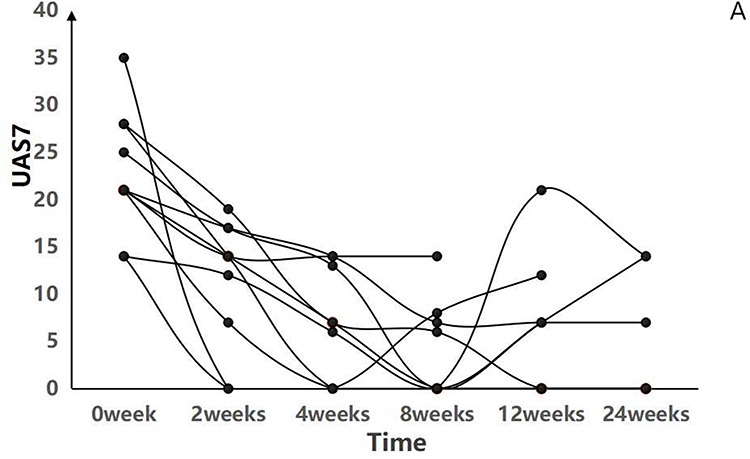 |
Figure 1 Treatment response. (A) Mean Change from Baseline in UAS7 During the Treatment Period. |
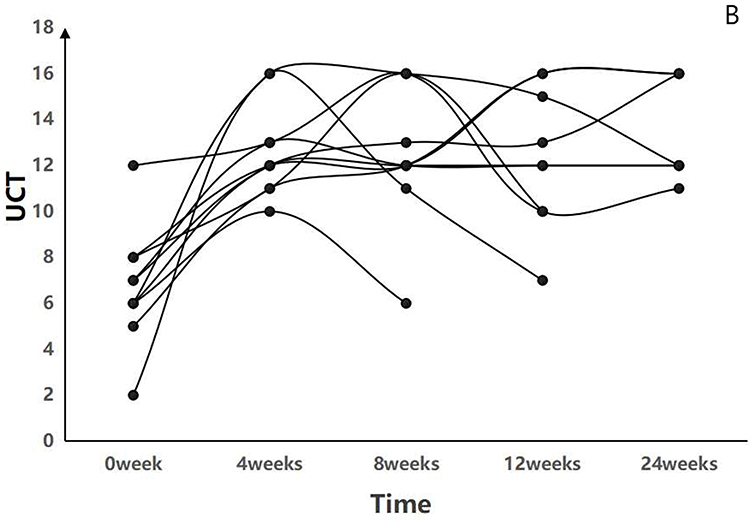 |
Figure 2 Treatment response. (B) Mean Change from Baseline in UCT During the Treatment Period. |
Overall, tofacitinib treatment effectively alleviates symptoms to a certain extent, with particularly noticeable effects during the first month of therapy. However, urticaria activity and control fluctuate during long-term continuous medication. Among the 10 patients in this study, 5 of the 7 patients who showed significant improvement in UAS7 and UCT scores after 8 weeks of treatment had total IgE levels below 100 IU/mL. Notably, 2 of these patients had a history of positive thyroid peroxidase antibodies and positive antinuclear antibodies, respectively. Furthermore, in this retrospective study, patients Case 1 and Case 6 demonstrated positive basophil activation tests. Both patients responded well within the first 4 weeks of tofacitinib treatment but experienced poor control of skin lesions and pruritus thereafter. Oral tofacitinib therapy was discontinued at Week 12 and Week 8, respectively.
Safety Outcomes
During treatment, two patients developed mild upper respiratory tract infections, both resolving with prompt symptomatic management. One patient exhibited mildly abnormal liver function markers, which normalized within one month after dose adjustment (5 mg/day). No serious adverse events occurred during treatment, indicating relatively favorable safety of tofacitinib in this study. However, given the small sample size, further observation with larger cohorts is warranted.
Discussion
Combined results from UCT and UAS7 scores indicate that tofacitinib indeed exerts a positive effect on symptoms in patients with CSU who show poor response to omalizumab. The trend in UCT scores indicates that tofacitinib can improve urticaria symptoms over time. Although fluctuations occurred in the later stages of treatment, the overall effect remained positive. Combined with the fluctuations in UAS7 scores, this suggests that tofacitinib alleviates urticaria symptoms across different dimensions during treatment. However, the therapeutic effect does not show a stable, sustained improvement, potentially influenced by factors such as patient individuality, drug tolerance, and dosage. Additionally, this study found that patients with lower total IgE levels or a history of thyroid peroxidase antibody positivity and antinuclear antibody positivity demonstrated superior efficacy within the first 8 weeks of tofacitinib treatment. This suggests that in these patients, mast cell activation may be more likely mediated by autoimmune mechanisms involving autoantibody-mediated Type IIb pathways and non-immune pathways mediated by non-IgE pathways. Such patients also tend to develop refractory CSU more frequently.3,4 In this study, two patients with positive basophil activation tests demonstrated good response within 4 weeks of tofacitinib treatment but subsequently experienced disease recurrence. This may further validate the central role of the FcεRI-Syk pathway in the autoantibody-mediated mast cell/basophil activation mechanism of such BAT-positive CSU patients, while tofacitinib has limited direct inhibitory effects on cell degranulation.11 Furthermore, all patients in this retrospective study had prior omalizumab treatment history. The observed efficacy at 8–12 weeks may also be related to the ongoing washout period from omalizumab. Future combination therapy may be explored to further validate efficacy.
Regarding safety, only mild adverse reactions occurred during tofacitinib treatment with no severe adverse events, indicating relatively stable safety in this study.
Furthermore, we searched PubMed for studies on JAK inhibitor treatment for CSU using the keywords: (“JAK inhibitor”) and (“chronic spontaneous urticaria”). No language or time restrictions were applied. The database search identified 4 studies involving 19 patients, among whom 6 cases of CSU with suboptimal response to omalizumab treatment meeting the inclusion criteria were identified. Table 2 summarizes disease duration, medication, dosage, treatment course, efficacy, and adverse events. Among these six patients, three were male and three were female, ranging in age from 26 to 45 years old. Disease duration ranged from 10 months to 2 years. One patient received oral tofacitinib, while the others received abulizumab. Following oral JAK inhibitor therapy, patients who failed omalizumab treatment achieved favorable outcomes, with five of six patients achieving complete remission. Regarding adverse reactions, consistent with our study, one patient each experienced mild liver function impairment, which resolved within a short period. The study did not identify superior tofacitinib efficacy in patients with low serum IgE levels or a history of thyroid peroxidase antibody positivity and antinuclear antibody positivity, as relevant values were not reported in the cases.12,13 An ongoing Phase III clinical trial (CTR20240829) evaluating a JAK1/TYK inhibitor (TLL-018) for CSU and a Phase II study (NCT05935657) of a JAK1 inhibitor (porvocitinib) for refractory CSU demonstrate significant efficacy and favorable safety profiles in refractory CSU.14
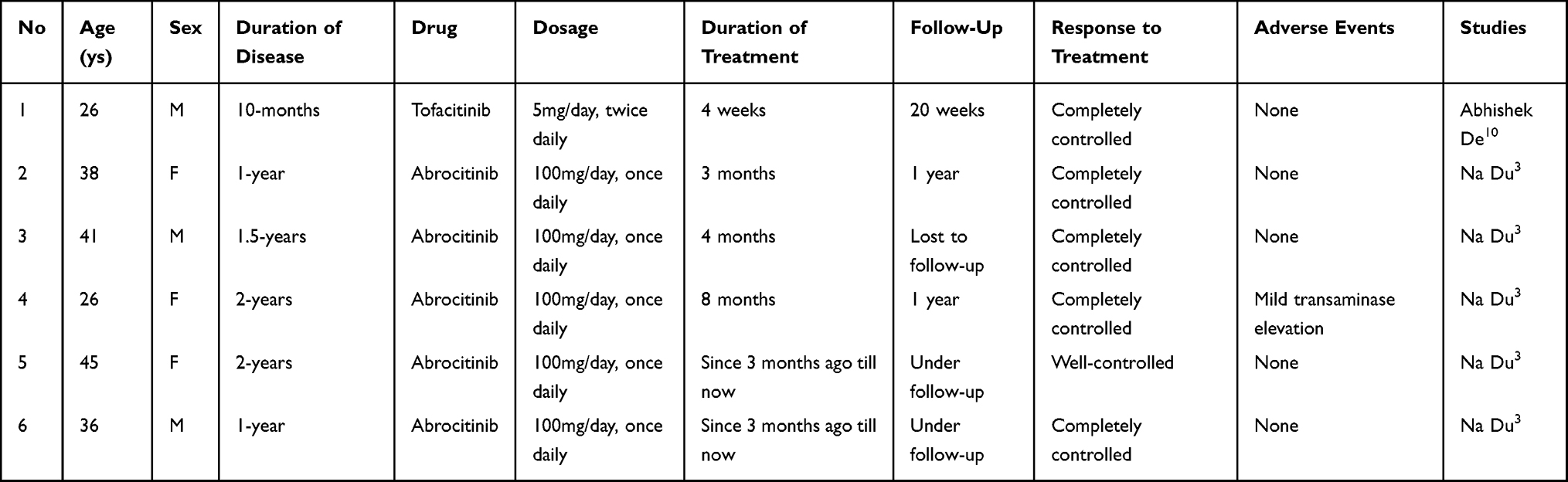 |
Table 2 Literature Review of Studies Investigating JAK Inhibitors in the Treatment of CSU |
Additionally, cyclosporine, previously the preferred oral medication for refractory CSU patients, achieved a 12-week response rate of 73.1% in treating refractory CSU patients,15 with particularly rapid and favorable responses in refractory type IIb CSU.16 However, its long-term use is limited by numerous adverse effects, including gastrointestinal reactions, hypertension, renal impairment, headaches, and hirsutism. Tofacitinib, exhibiting fewer adverse reactions compared to cyclosporine, holds promise as an oral alternative following omalizumab treatment failure.
Conclusion
In summary, this retrospective study provides preliminary evidence supporting the therapeutic potential of tofacitinib for chronic spontaneous urticaria (CSU) patients with suboptimal or inadequate response to omalizumab, demonstrating efficacy in symptom alleviation. However, the small sample size and retrospective design inherently limit the robustness and generalizability of the findings. To further elucidate the underlying therapeutic mechanisms of tofacitinib, establish evidence-based optimal dosing strategies, and validate the precise utility of the Urticaria Control Test (UCT) score as a clinical endpoint, future prospective, large-scale, multicenter clinical trials are warranted.
Abbreviations
CSU, Chronic spontaneous urticaria; UCT, Urticaria Control Test; UAS7, Urticaria Activity Score over 7 days.
Ethics and Consent Statement
The Ethics Committee of the Third People’s Hospital of Hangzhou, in accordance with national regulations and the Declaration of Helsinki, has approved the exemption of informed consent from patients for this study on the premise of ensuring patient privacy and strict confidentiality of data. The reason is that this study is a retrospective analysis with extremely low risk, and obtaining individual consent for a large number of historical medical records is not feasible.This case report was conducted in accordance with the Declaration of Helsinki (as revised in 2013, Fortaleza, Brazil) and approved by the Ethics Committee of Hangzhou Third People’s Hospital (Approval No. 2025KA185).
In this study, the use of tofacitinib in the treatment of patients with chronic spontaneous urticaria was off-label. However, in accordance with the Chinese Guidelines for the Diagnosis and Treatment of Refractory Chronic Spontaneous Urticaria (2025), this treatment regimen conformed to the diagnostic and therapeutic standards. Moreover, all patients signed the informed consent form for the off-label use of tofacitinib before oral administration of the drug.
Funding
This work was supported by Zhejiang Province Clinical Research Project on Traditional Chinese Medicine (2026ZL0620) and Chronic Disease Management Research Project of National Health Commission Capacity Building and Continuing Education Center (GWJJMB202510025011).
Disclosure
The authors report no conflicts of interest in this work.
References
1. Kolkhir P, Giménez-Arnau AM, Kulthanan K, et al. Urticaria. Nat Rev Dis Primers. 2022;8(1):61. doi:10.1038/s41572-022-00389-z
2. Li J, Mao D, Liu S, et al. Epidemiology of urticaria in China: a population-based study. Chin Med J. 2022;135(11):1369–7. doi:10.1097/CM9.0000000000002172
3. Bracken SJ, Abraham S, MacLeod AS. Autoimmune theories of chronic spontaneous urticaria. Front Immunol. 2019;10:627. doi:10.3389/fimmu.2019.00627
4. He L, Yi W, Huang X, et al. Chronic urticaria: advances in understanding of the disease and clinical management. Clin Rev Allergy Immunol. 2021;61(3):424–448. doi:10.1007/s12016-021-08886-x
5. Zhou B, Li J, Liu R, et al. The role of crosstalk of immune cells in pathogenesis of chronic spontaneous urticaria. Front Immunol. 2022;13:879754. doi:10.3389/fimmu.2022.879754
6. Church MK, Kolkhir P, Metz M, et al. The role and relevance of mast cells in urticaria. Immunol Rev. 2018;282(1):232–247. doi:10.1111/imr.12632
7. Zuberbier T, Abdul Latiff AH, Abuzakouk M, et al. The international EAACI/GA2LEN/EuroGuiDerm/APAAACI guideline for the definition, classification, diagnosis, and management of urticaria. Allergy. 2022;77(3):734–766. doi:10.1111/all.15090
8. Kolkhir P, Bonnekoh H, Metz M, et al. Chronic Spontaneous Urticaria: a Review. JAMA. 2024;332(17):1464–1477. doi:10.1001/jama.2024.15568
9. De A, Shah B, Banodkar PD, et al. Indian Association of Dermatologists, Venereologists and Leprologists (IADVL) Task Force on Urticaria: consensus statement on management of chronic spontaneous urticaria. Indian J Dermatol. 2023;68(6):674–677. doi:10.4103/ijd.ijd_89_23
10. Bernstein JA, Maurer M, Saini SS. BTK signaling—a crucial link in the pathophysiology of chronic spontaneous urticaria. J Allergy Clin Immunol. 2024;153(5):1229–1240. doi:10.1016/j.jaci.2023.12.008
11. Kolkhir P, Church MK, Weller K, et al. Autoimmune chronic spontaneous urticaria: what we know and what we do not know. J Allergy Clin Immunol. 2017;139(6):1772–1781. doi:10.1016/j.jaci.2016.08.050
12. De A, Das S, Pal S, et al. An open-label, investigator-initiated, single-centre pilot study to determine the safety and efficacy of tofacitinib in resistant chronic spontaneous urticaria. Indian J Dermatol. 2024;69(4):312–316. doi:10.4103/ijd.ijd_1085_23
13. De A, Pal S, Singh S, et al. Case report: exploration of abrocitinib in the treatment of refractory chronic spontaneous urticaria: a case series. Front Immunol. 2024;15:1466058. doi:10.3389/fimmu.2024.1466058
14. Lu Q, Yang B, Liu L, et al. Efficacy and safety of TLL-018 in moderate to severe chronic spontaneous urticaria patients with inadequate response to H1 antihistamine: results from a Phase 2 study. J Allergy Clin Immunol. 2024;153(2):AB372. doi:10.1016/j.jaci.2023.11.891
15. Kulthanan K, Chaweekulrat P, Komoltri C, et al. Cyclosporine for chronic spontaneous urticaria: a meta-analysis and systematic review. J Allergy Clin Immunol Pract. 2018;6(2):586–599. doi:10.1016/j.jaip.2017.07.017
16. Endo T, Toyoshima S, Kanegae K, et al. Identification of biomarkers for predicting the response to cyclosporine A therapy in patients with chronic spontaneous urticaria. Allergol Int. 2019;68(2):270–273. doi:10.1016/j.alit.2018.09.006
 © 2026 The Author(s). This work is published and licensed by Dove Medical Press Limited. The
full terms of this license are available at https://www.dovepress.com/terms
and incorporate the Creative Commons Attribution
- Non Commercial (unported, 4.0) License.
By accessing the work you hereby accept the Terms. Non-commercial uses of the work are permitted
without any further permission from Dove Medical Press Limited, provided the work is properly
attributed. For permission for commercial use of this work, please see paragraphs 4.2 and 5 of our Terms.
© 2026 The Author(s). This work is published and licensed by Dove Medical Press Limited. The
full terms of this license are available at https://www.dovepress.com/terms
and incorporate the Creative Commons Attribution
- Non Commercial (unported, 4.0) License.
By accessing the work you hereby accept the Terms. Non-commercial uses of the work are permitted
without any further permission from Dove Medical Press Limited, provided the work is properly
attributed. For permission for commercial use of this work, please see paragraphs 4.2 and 5 of our Terms.
Recommended articles


Changes of Gut Microbiome in Adolescent Patients with Chronic Spontaneous Urticaria After Omalizumab Treatment
Wang M, Zhao L, Wang K, Qin Y, Jin J, Wang D, Yan H, You C
Clinical, Cosmetic and Investigational Dermatology 2023, 16:345-357
Published Date: 4 February 2023
Case Series and Literature Review on Tofacitinib for Treating Severe Alopecia Areata
He J, Yao L, Lan N, Zhu L, Lv Y
Clinical, Cosmetic and Investigational Dermatology 2025, 18:3051-3059
Published Date: 15 November 2025
Analysis of Predictors of Response Degree to Omalizumab in 124 Patients with Chronic Spontaneous Urticaria
Li C, Cai X, Wang M
Clinical, Cosmetic and Investigational Dermatology 2026, 19:603156
Published Date: 17 July 2026