
Back to Journals » Clinical Interventions in Aging » Volume 20
Exercise Identity and Spiritual Well-Being in Nursing Home Residents: Mediating Roles of Social Support and Exercise Behavior in Hebei Province, China
Authors Luo S  , Wu LM , Wang Y, Jin HQ, Zhao YN, Du XF
Received 31 January 2025
Accepted for publication 19 July 2025
Published 26 July 2025 Volume 2025:20 Pages 1099—1108
DOI https://doi.org/10.2147/CIA.S520138
Checked for plagiarism Yes
Review by Single anonymous peer review
Peer reviewer comments 4
Editor who approved publication: Dr Zhi-Ying Wu
Shan Luo,1 Li Ming Wu,1 Yan Wang,1 Hong Qin Jin,1 Ya Ning Zhao,2 Xiao Fei Du1
1Department of Nursing, Tangshan Vocational & Technical College, Tangshan, Heibei, 063000, People’s Republic of China; 2College of Nursing and Rehabilitation, North China University of Science and Technology, Tangshan, Heibei, 063210, People’s Republic of China
Correspondence: Li Ming Wu, Department of Nursing, Tangshan Vocational & Technical College, Tangshan, Heibei, People’s Republic of China, Email [email protected]
Objective: With China’s rapidly aging population, institutional care for older adults is becoming increasingly common. Spiritual well-being has emerged as a key component of quality elderly care, contributing to emotional resilience, life satisfaction, and positive aging. This study explores the impact of exercise identity on the Spiritual well-being of older adults residing in nursing homes and the mediating roles of perceived social support and exercise behavior.
Methods: A survey was conducted on 514 older adults residing in nursing homes using general demographic questionnaires, the Spirituality Index of Well-Being Scale, the Perceived Social Support Scale, the Physical Activity Rating Scale, and the Exercise Identity Scale.
Results: The total score of Spiritual well-being among older adults residing in nursing homes was (32.76 ± 7.07). Significant positive correlations were found among exercise identity, perceived social support, exercise behavior, and Spiritual well-being. Perceived social support partially mediated the relationship between exercise identity and Spiritual well-being, with an indirect effect value of 0.237, accounting for 39.6% of the total effect (0.599). Exercise behavior also partially mediated the relationship between exercise identity and Spiritual well-being, with an indirect effect value of 0.201, accounting for 33.5% of the total effect (0.599).
Conclusion: Perceived social support and exercise behavior have parallel mediating effects on the relationship between exercise identity and Spiritual well-being of older adults residing in nursing homes. These findings offer a theoretical foundation for developing targeted interventions aimed at enhancing spiritual well-being through improved exercise identity and supportive environments in institutional care settings.
Keywords: older adults in nursing homes, exercise identity, spiritual well-being, perceived social support, exercise behavior
Introduction
Population ageing is a global trend. According to the World Health Organization, by 2050, the number of people aged 60 years and older will double to 2.1 billion, accounting for over 20% of the global population. As longevity increases worldwide, promoting spiritual well-being in later life has become an essential part of holistic elderly care.1 China is one of the countries with the largest elderly population and the fastest aging rate globally. In 2020, the population aged over 60 and over 65 in China reached 264 million and 191 million, respectively, and it is projected that by 2050, the population aged over 60 will account for 34.8% of the total population.2 With economic and social development, institutional elderly care has gradually become one of the popular options for aging care among the elderly in China.3 Spiritual well-being represents a deeper exploration of well-being, encompassing subjective emotional pleasure, an intrinsic sense of self-fulfillment, and profound spiritual experiences where self and surroundings merge seamlessly.4 Spiritual well-being play a crucial role in guiding the lives of elderly individuals. Research shows that it helps seniors clarify the meaning of life, cope with harmful environments, provide spiritual support, and foster positive emotions to address the challenges of aging. It positively impacts their quality of life and outcomes related to mortality.5,6 Therefore, in the face of an increasingly severe aging problem, it is significant to explore the factors affecting the spiritual well-being of older adults in nursing homes and their underlying mechanisms. Older adults living in nursing homes often face unique psychosocial challenges such as reduced autonomy, limited social interaction, loneliness, and a perceived loss of identity.7 These challenges may negatively impact their spiritual well-being by increasing emotional distress and weakening their sense of purpose and connection.
Exercise identity refers to the process in which individuals incorporate the role of being an exerciser into their self-concept, reflecting their self-identification with the role of exercising and physical activity.8 Studies have shown that exercise identity positively impacts individuals’ exercise motivation, exercise adherence, and physical and mental health.9 Identity theory suggests that identity provides individuals with a self-regulatory system, allowing them to act according to the meaning of their identity. The emotional experiences resulting from identity consistency or inconsistency can long-term impact individuals’ spiritual well-being.10,11 Therefore, we propose that exercise identity may encourage elderly individuals to exhibit positive attitudes, emotions, and behaviors that align with their identity, thereby improving their spiritual well-being.
Perceived social support refers to individuals’ subjective understanding and evaluation of the social support they receive.12 Social identity theory and self-categorization theory suggest that social identity helps individuals acquire psychological resources consistent with their self-concept, enhancing perceived social support. In other words, social identity is a prerequisite for individuals to recognize, accept, and effectively utilize social support.13 Studies have shown that individuals with a higher social identity perceive more social support in stressful situations.14 Since exercise identity encompasses both group-level and individual-level identity, elderly individuals with higher exercise identity may perceive greater social support.13 Furthermore, perceived social support has been demonstrated to be closely related to spiritual well-being among the elderly.15 Thus, we propose that exercise identity can indirectly predict spiritual well-being among elderly individuals through perceived social support.
Studies have found that individuals with a strong sense of exercise identity tend to exhibit positive exercise behaviors.16 It is believed that individuals with a high level of exercise identity or those who consider themselves exercisers are more likely to engage in physical exercise and related activities than those who do not. They are also more likely to resume exercise plans and implement exercise intentions after inactivity.17 Exercise identity positively affects individuals’ exercise motivation and adherence, significantly promoting participation in physical exercise.18 Thus, exercise identity is essential for individuals to engage in physical exercise and related activities. Physical exercise directly mitigates the disuse caused by physical functional decline, enhancing individuals’ sense of self-control and self-efficacy.19 Additionally, it helps elderly individuals reduce risk factors, strengthens their sense of control and value, and positively affects their spiritual well-being.20 Therefore, we propose that exercise identity can indirectly predict spiritual well-being among elderly individuals by increasing their exercise behaviors.
In summary, this study proposes the following hypothesis: perceived social support and exercise behavior mediate the relationship between exercise identity and spiritual well-being among older adults residing in nursing homes. A structural equation model will be constructed and tested to clarify the influence pathways and related effects among variables, providing a basis for developing intervention measures to enhance spiritual well-being in older adults of nursing homes. Despite increasing attention to elderly care, few empirical studies have explored the mechanisms linking exercise identity to spiritual well-being, particularly within institutional settings. This study addresses this gap by constructing and testing a structural equation model to reveal the mediating roles of perceived social support and exercise behavior.
Methods
Study Participants
This study used convenience sampling to collect data from two nursing homes. The inclusion criteria for the nursing homes were as follows: operating steadily for ≥1 year, at least 30 available beds, and willingness to participate in the study. The inclusion criteria for participants were as follows: (1) aged 60 years or older; (2) residing in the nursing home for at least 3 consecutive months; (3) voluntarily participating in the survey with informed consent; (4) having good cognitive abilities and being able to understand the questionnaire, assessed using the Mini-Mental State Examination (MMSE) with a score of ≥24.; and (5) being able to express their opinions clearly. Participants were excluded if they met any of the following conditions: (1) having severe mental health problems or (2) having severe physical illnesses. As the participants were selected using convenience sampling from only two nursing homes in Hebei Province, there is a potential risk of selection bias. To minimize this, we applied strict inclusion and exclusion criteria and ensured that all interviews were conducted by trained personnel following standardized procedures.
Based on Kendall’s sample size estimation method, which suggests that the minimum sample size should be 10 to 15 times the number of independent variables, the required sample size for this study (with 16 independent variables) was calculated to be between 160 and 240 participants. To account for a possible 15% rate of invalid or incomplete responses, an additional 36 participants were considered, resulting in an adjusted range of 184 to 276 participants. Ultimately, a total of 514 valid responses were collected, exceeding the required threshold and ensuring sufficient statistical power for analysis. This study was approved by the Ethics Committee of North China University of Science and Technology (Approval Number: 2022098) and was conducted in accordance with the Declaration of Helsinki.
Research Instruments
Spirituality Index of Well-Being Scale (SIWB)
The SIWB developed by Daaleman et al was used to assess spiritual well-being. The scale includes two dimensions: self-efficacy (eg, “I am able to find meaning in daily life”) and life meaning (eg, “I have a sense of purpose in my life”), with 12 items in total (6 per dimension). A 5-point Likert scale is used, ranging from “1 = strongly disagree” to “5 = strongly agree”. Higher scores reflect a greater level of spiritual well-being. The SIWB has shown good psychometric properties among older adults in China.21
Exercise Identity Scale (EIS)
The EIS, developed by Anderson et al, measures the degree to which individuals incorporate physical activity into their self-concept. The scale consists of 9 items (eg, “I consider myself an exerciser” or “Exercising is a central part of who I am”) and reflects a unidimensional structure. Each item is scored on a 7-point Likert scale from “1 = strongly disagree” to “7 = strongly agree”. Higher scores represent a stronger exercise identity. This scale has demonstrated good reliability and cultural adaptability in Chinese populations.22
Perceived Social Support Scale (PSSS)
The PSSS, developed by Zhang et al,16 includes three dimensions: family support (4 items), friend support (4 items), and other support (4 items), with a total of 12 items. A 7-point Likert scale is used for scoring, ranging from “1 = strongly disagree” to “7 = strongly agree”. The total score ranges from 12 to 84, with higher scores indicating greater perceived social support. The scale’s Cronbach’s α coefficient is 0.88; in this study, it was 0.917.
Physical Activity Rating Scale (PARS)
The Physical Activity Rating Scale, developed by Liang Deqing et al, was used to measure physical exercise behavior among older adults residing in nursing homes.23 The scale evaluates physical exercise based on intensity, duration, and frequency of participation. A 5-point Likert scale is used for scoring, and the total score is calculated using the following formula: Exercise Volume = Intensity × Duration × Frequency. The total score ranges from 0 to 100, with higher scores indicating greater exercise intensity, higher frequency, and longer duration. Previous studies have demonstrated good reliability and validity for this scale.
Data Collection Methods
After obtaining informed consent from the participants, the researchers used standardized instructions to explain the purpose of the survey and confidentiality principles, ensuring that participants fully understood the voluntary nature and importance of the study. Two trained researchers collected the required information through face-to-face interviews. Upon completing the survey, the researchers immediately reviewed the quality of the questionnaires. If there were doubts or missing answers, the researchers personally confirmed the responses with the participants through on-site inquiries. Although formal inter-rater reliability testing (eg, Cohen’s kappa) was not conducted, the research team implemented multiple quality control measures to ensure data consistency and reliability. All interviewers received standardized training before data collection and followed uniform instructions and procedures throughout the process. Additionally, the entire survey was supervised by the principal investigator, and all completed questionnaires were reviewed on-site to ensure logical consistency and completeness. As a result, the final dataset included only valid responses with no missing values.
Statistical Methods
SPSS 26.0 software was used for statistical data analysis. Count data were expressed as frequencies, percentages, and composition ratios, while normally distributed measurement data were expressed as mean ± standard deviation. Pearson correlation coefficients (r) were used to represent the linear relationships between two variables, with a significance level of <0.05. AMOS 26.0 statistical software was used to construct a structural equation model to analyze the effects of exercise identity, perceived social support, and exercise behavior on the spiritual well-being of older adults residing in nursing homes. The maximum likelihood (ML) method was used to test the model’s path coefficients, and the model’s credibility was assessed by evaluating model fit indices. The bootstrap method was employed to test the significance of mediation effects, using the Bootstrap ML approach with 5000 resamples to examine the results of the mediation effects.
Results
General Information on Older Adults Residing in Nursing Homes
A total of 514 elderly residents older adults aged 60 years and above in nursing homes were surveyed in this study. The sociodemographic characteristics of the participants are shown in Table 1.
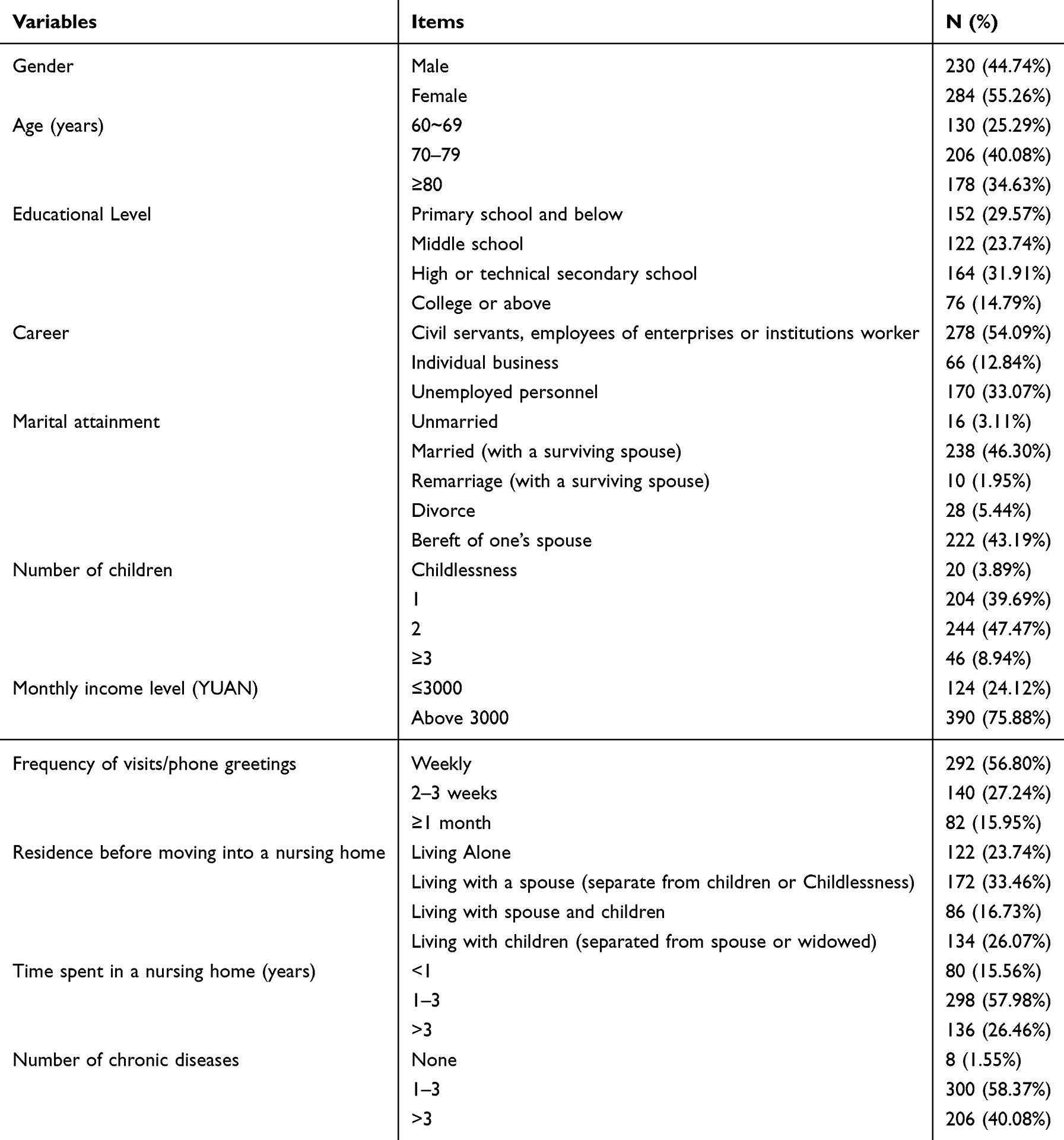 |
Table 1 Sociodemographic Characteristics of Elderly People in Elderly Care Institutions (n = 514) |
Descriptive Statistics and Correlation Analysis of Study Variables
The mean score for exercise identity was 37.45 ± 4.29 (out of a possible 63), indicating a moderate level of identification with the role of an exerciser. For perceived social support, the total score was 50.06 ± 9.62 (out of 84), with family support (17.92 ± 2.71) being the highest among the three sources, followed by other support (16.24 ± 3.82) and friend support (15.90 ± 4.21). The average score for spiritual well-being was 32.76 ± 7.06 (out of 60), including self-efficacy (16.86 ± 3.41) and meaning in life (15.90 ± 4.21), both at a moderate level. Physical activity levels were low in this sample, with an average score of 18.66 ± 5.46 (out of 100), suggesting limited exercise engagement among the participants. The results of the correlation analysis revealed significant positive correlations among exercise identity, perceived social support, exercise behavior, and spiritual well-being. The descriptive statistics and correlation coefficients of the variables are shown in Table 2.
 |
Table 2 Descriptive Statistics and Correlation Coefficient Matrix (r) |
Mediation Effect Testing
This study conducted a mediation effect test using a structural equation model (Figure 1). The model fit indices were as follows: normed fit index (NFI) = 0.977, comparative fit index (CFI) = 0.983, Tucker-Lewis index (TLI) = 0.967, incremental fit index (IFI) = 0.983, and root mean square error of approximation (RMSEA) = 0.077. Based on these results, the model demonstrates a good fit.
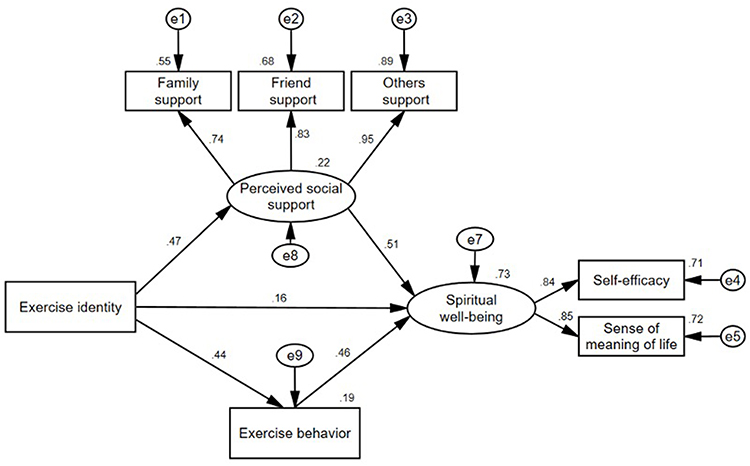 |
Figure 1 Analysis of the mediating effect of perceived social support and exercise behavior on exercise identity and spiritual well-being of older adults residing in nursing homes (standardized coefficients). |
Analysis of the Mediating Effects of Perceived Social Support and Exercise Behavior
To further examine the mediating effects of perceived social support and exercise behavior on the relationship between exercise identity and spiritual well-being among older adults residing in nursing homes, a structural equation modeling (SEM) approach was used. The Bootstrap ML method with 5000 resamples tested the significance of indirect effects. Table 3 presents the standardized path coefficients, with values above 0.1 indicating moderate effects and values above 0.3 suggesting stronger effects. This model allows for the simultaneous estimation of direct and indirect effects, offering a comprehensive view of the mediating mechanisms.
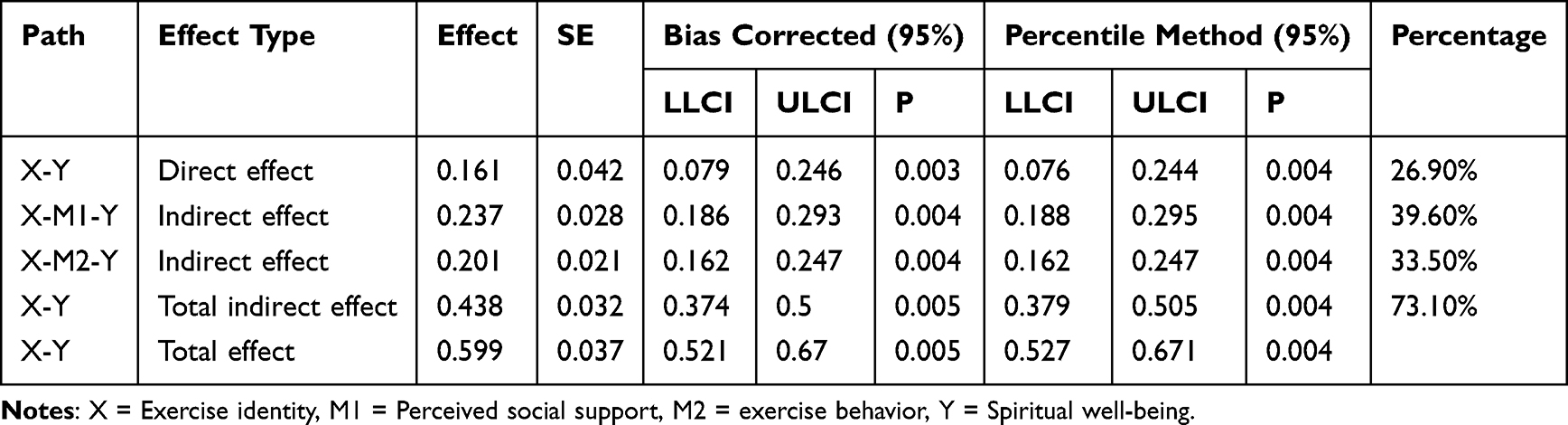 |
Table 3 Mediating Effects of Perceived Social Support and Exercise Behavior on the Relationship Between Exercise Identity and Spiritual Well-Being Among Older Adults Residing in Nursing Homes (Standardized Coefficients) |
Discussion
Spiritual Well-Being of Older Adults Residing in Nursing Homes
The results of this study indicate that the total score for spiritual well-being among older adults residing in nursing homes was (32.76 ± 7.07), suggesting that their spiritual well-being is at a moderately low level. This score is slightly lower than the findings of Chen Keyi et al regarding the spiritual well-being of elderly individuals in the community.24 This discrepancy may be attributed to differences in the study populations or the lower quality of institutional elderly care services, which often prioritize daily living assistance while neglecting spiritual comfort.25 This difference highlights the need to consider the unique challenges faced by institutionalized older adults compared to their community-dwelling counterparts. Therefore, nursing home staff should pay greater attention to the spiritual well-being of older adults. From the perspective of positive psychology, psychological interventions such as reminiscence therapy and psychotherapy could be employed to foster positive psychological emotions, activate inner potential, and alleviate the physical and mental stress associated with aging. These measures can help improve the spiritual well-being of older adults.26
The Impact of Exercise Identity on the Spiritual Well-Being of Older Adults Residing in Nursing Homes
The results of this study indicate a significant positive correlation between exercise identity and spiritual well-being among older adults residing in nursing homes. Exercise identity was found to be an important positive predictor of spiritual well-being. Although the decline in physical function in elderly individuals may reduce their motivation to participate in physical exercise to some extent, a positive exercise identity encourages them to exhibit attitudes, emotions, and behaviors consistent with their identity, such as heightened awareness of physical fitness and active participation in appropriate physical exercises.27 The findings of this study also indirectly support the self-enhancement theory. For elderly individuals with high exercise identity, engaging in behaviors consistent with their exercise identity inherently achieves the purpose of self-enhancement, thereby improving their spiritual well-being.28
The Mediating Role of Perceived Social Support Between Exercise Identity and Spiritual Well-Being Among Older Adults Residing in Nursing Homes
The results of this study indicate that elderly individuals with higher exercise identity perceive greater available social support. Social identity theory and self-categorization theory suggest that social identity helps individuals acquire psychological resources consistent with their self-concept, enhancing perceived social support. In other words, social identity is the foundation for individuals to recognize, accept, and effectively utilize social support.14 Empirical research has shown that individuals with higher social identity perceive more social support in stressful situations.29 Since exercise identity encompasses group and individual-level identification, elderly individuals with higher exercise identity are likely to perceive greater social support.
The results of this study indicate that higher levels of perceived social support are associated with better mental health and well-being. This may be because individuals who receive more support are more satisfied with their social relationships, which enhances their well-being.30 Research on mental health has found that perceived social support is an important coping mechanism that reduces psychological distress and promotes positive emotions.31 The concept of perceived social support is crucial because underestimating the impact of social support may diminish its benefits, regardless of the level of physical and emotional support provided.32 The nursing home environment differs from home and community settings, so perceived social support is critical. A strong perceived social support network can improve access to positive psychological resources, which can mitigate negative emotions such as anxiety and depression.33 Moreover, perceived social support can provide individuals with strategies for problem-solving, minimizing the severity of issues, and alleviating any related adverse effects.34
Therefore, older adults residing in nursing homes with higher levels of exercise identity are more likely to accept the social support provided by their group, resulting in a greater perception of available social support. According to the stress-buffering model of social support, social support can effectively buffer stress—such as reducing negative emotions like depression and anxiety—only when elderly individuals perceive sufficient support. This, in turn, enhances positive emotions, improves social adaptation, strengthens interpersonal relationships, and ultimately boosts spiritual well-being.35 Nursing homes should establish health management systems for older adults and actively organize socially engaging activities to help them adapt to institutional life, foster a sense of belonging, and regain control over their lives. Encouraging visits from family and friends to strengthen emotional connections and implementing activities like narrative care and cultural or recreational events can help older adults experience the beauty of life and find meaning in it.
The Mediating Role of Exercise Behavior Between Exercise Identity and Spiritual Well-Being Among Older Adults in Nursing Homes
The results of this study indicate that a strong exercise identity is a significant predictor of exercise behavior, which is consistent with the findings of Rhodes et al.17 This is because exercise identity gives individuals an automatic drive to perform behaviors that align with their identity as exercisers (eg, participating in weekly exercise). Furthermore, exercise identity is associated with intrinsic motivation and self-regulation, enabling individuals to adapt their exercise-related perspectives and behaviors to maintain exercise habits, even when facing obstacles such as changes in motivation or physical capacity.36
The results also reveal a positive correlation between physical exercise and spiritual well-being. Older adults residing in nursing homes who engage in more physical exercise tend to have higher levels of spiritual well-being, which aligns with the study findings of Yang et al.37 Although the average physical activity score was relatively low (18.66 ± 5.46 out of 100), the significant mediating effect observed suggests that even limited engagement in exercise can meaningfully contribute to spiritual well-being among institutionalized older adults. This may indicate that for this population, small amounts of physical activity still play a psychologically beneficial role. First, physical exercise enhances the flow experience of elderly individuals, a transcendental mental state that helps improve spiritual well-being. Second, physical exercise effectively enhances coping mechanisms. Research has shown that individuals who regularly participate in physical exercise exhibit greater cognitive flexibility and adopt more positive coping strategies, which makes them more likely to achieve higher levels of spiritual well-being.
Therefore, older adults residing in nursing homes with higher levels of exercise identity view themselves as exercisers and are driven by their self-perception to engage in physical exercise behaviors. As a result, they have a stronger desire to exercise, spend more time on physical activities, and participate in more sports activities. These activities not only occupy their time but also fulfill their needs for social interaction and entertainment, helping them regulate negative emotions and improve their coping mechanisms, ultimately leading to higher levels of spiritual well-being. Moreover, this study did not assess participants’ functional dependency using instruments such as the Activities of Daily Living (ADL) scale. Since functional status may influence exercise identity and engagement, future studies should consider incorporating dependency measures to better explore these relationships.
Limitations and Future Research Directions
This study’s sample was limited to nursing homes in Hebei Province, which may introduce bias into the findings. Future research could conduct qualitative and longitudinal studies on the spiritual well-being of older adults residing in nursing homes to comprehensively explore the influencing factors and dynamic changes in spiritual well-being among the elderly. Additionally, multi-center, large-sample, and high-quality intervention studies should be conducted to provide evidence for developing interventions promoting active aging in nursing homes.
Conclusion
Our findings indicate that exercise identity has a direct positive impact on the spiritual well-being of older adults residing in nursing homes. Moreover, it influences spiritual well-being indirectly through the mediating roles of perceived social support and exercise behavior. This study was conducted in two large-scale nursing homes in Hebei Province, where residents often face limited access to individualized spiritual care and physical activity opportunities. Therefore, the results are particularly relevant to similar institutional contexts in China and other regions with rapidly aging populations. These findings provide valuable evidence for the development of tailored interventions and policies aimed at enhancing the spiritual well-being of institutionalized older adults. Promoting exercise identity, strengthening perceived social support, and encouraging even small amounts of physical activity may be effective strategies to improve quality of life and mental resilience in this vulnerable population.
Abbreviations
SIWB, Spirituality Index of Well-Being Scale; EIS, Exercise Identity Scale; PSSS, Perceived Social Support Scale; PARS, Physical Activity Rating Scale; ML, Maximum Likelihood Method; NFI, Normed Fit Index; CFI, Comparative Fit Index; TLI, Tucker-Lewis Index; IFI, Incremental Fit Index; RMSEA, Root Mean Square Error of Approximation.
Acknowledgments
The authors would like to thank the local team members from two nursing homes in Tangshan City for their assistance with data collection, as well as all the elderly participants for their support. In addition, the study team used an unauthorized version of the Chinese MMSE without permission; however, this has now been rectified with PAR. The MMSE is a copyrighted instrument and may not be used or reproduced in whole or in part, in any form or language, or by any means without written permission from PAR (www.parinc.com).
Funding
This study was supported by the 2024 Hebei Province Social Science Development Research Project (No. 202403235), the 2024 Tangshan City Social Science Development Research Project (No. TSSKL2024-052), and the 2024 Tangshan Vocational & Technical College Institutional Research Project (No. Y24-06).
Disclosure
The authors declare no conflicts of interest in this work.
References
1. World Health Organization. Ageing and health [Internet]. Geneva: World Health Organization; 2021 [cited May 21, 2025]. Available from: https://www.who.int/news-room/fact-sheets/detail/ageing-and-health.
2. Liu X, Yang QY, Zhang JM, Li SH. Investigation on the medication use among elderly patients in an old-age care institution of medical-nursing combined in Shanghai. China Pharm. 2024;33(24):30–34. doi:10.3969/j.issn.1006-4931.2024.24.006
3. Zhou JG, Yuan TT, Li GX, Tian QF. Influencing factors of the expected pension mode of the elderly. J Zhengzhou Univ. 2024;59(06):792–796. doi:10.13705/j.issn.1671-6825.2023.11.061
4. Jones CLC. Spiritual well-being in older adults: a concept analysis. J Christ Nurs. 2020;37(4):E31–E38. doi:10.1097/CNJ.0000000000000770
5. Langevin HM. Health and well-being: distinct and intertwined concepts. Med Care. 2024;62(12 Suppl 1):S13–S14. doi:10.1097/MLR.0000000000002061
6. Özdemir AA, Kavak Buda F, Dural G, Gültekin A. The relationship between spiritual well-being, life satisfaction and hope in elderly individuals in Turkey. J Relig Health. 2023;62(5):3123–3136. doi:10.1007/s10943-022-01517-5
7. Lapane KL, Lim E, McPhillips E, Barooah A, Yuan Y, Dube CE. Health effects of loneliness and social isolation in older adults living in congregate long term care settings: a systematic review of quantitative and qualitative evidence. Arch Gerontol Geriatr. 2022;102:104728. doi:10.1016/j.archger.2022.104728
8. Porter CD, Kwan MYW, Meca A, Brown DMY. Exercise identity and physical activity behavior during late adolescence: a four wave cross-lagged panel model. Psychol Sport Exerc. 2024;73:102641. doi:10.1016/j.psychsport.2024.102641
9. Espernberger K, Fini NA, Peiris CL. Identity, social engagement and community participation impact physical activity levels of stroke survivors: a mixed-methods study. Clin Rehabil. 2023;37(6):836–850. doi:10.1177/02692155221141977
10. de Hoog N, Pat-El R. Social identity and health-related behavior: a systematic review and meta-analysis. Soc Sci Med. 2024;344:116629. doi:10.1016/j.socscimed.2024.116629
11. Rousseau FL, Vallerand RJ. An examination of the relationship between passion and subjective well-being in older adults. Int J Aging Hum Dev. 2008;66(3):195–211. doi:10.2190/AG.66.3.b
12. Procidano ME, Heller K. Measures of perceived social support from friends and from family: three validation studies. Am J Community Psychol. 1983;11(1):1–24. doi:10.1007/BF00898416
13. Ntontis E, Drury J, Amlôt R, Rubin GJ, Williams R, Saavedra P. Collective resilience in the disaster recovery period: emergent social identity and observed social support are associated with collective efficacy, well-being, and the provision of social support. Br J Soc Psychol. 2021;60(3):1075–1095. doi:10.1111/bjso.12434
14. Patton KA, Ware R, McPherson L, Emerson E, Lennox N. Parent-related stress of male and female carers of adolescents with intellectual disabilities and carers of children within the general population: a cross-sectional comparison. J Appl Res Intellect Disabil. 2018;31(1):51–61. doi:10.1111/jar.12292
15. Ilyas Z, Shahed S, Hussain S. An impact of perceived social support on old age well-being mediated by spirituality, self-esteem and ego integrity. J Relig Health. 2020;59(6):2715–2732. doi:10.1007/s10943-019-00969-6
16. Wan X, Ren Y. Exercise identity, exercise behavior and mobile phone addiction: a cross-sectional mediation study with a sample of rural left-behind children in China. Heliyon. 2023;9(4):e14953. doi:10.1016/j.heliyon.2023.e14953
17. Roach J, Tabaczynski A, Goodman W, Trinh L. “I have to get up and exercise because that’s how I’m going to get over this”: a qualitative exploration of exercise identity and behavior in early cancer survivorship. Cancer Causes Control. 2024;35(8):1111–1121. doi:10.1007/s10552-024-01875-3
18. Gillman AS, Stevens CJ, Bryan AD. Women’s exercise identity increases after a 16-week exercise RCT and is linked to behavior maintenance at follow-up. Psychol Sport Exerc. 2021;54:101888. doi:10.1016/j.psychsport.2021.101888
19. Tikac G, Unal A, Altug F. Regular exercise improves the levels of self-efficacy, self-esteem and body awareness of young adults. J Sports Med Phys Fitness. 2022;62(1):157–161. doi:10.23736/S0022-4707.21.12143-7
20. Bertozzi B, Tosti V, Fontana L. Beyond calories: an integrated approach to promote health, longevity, and well-being. Gerontology. 2017;63(1):13–19. doi:10.1159/000446346
21. Daaleman TP, Frey BB. The spirituality index of well-being: a new instrument for health-related quality-of-life research. Ann Fam Med. 2004;2(5):499–503. doi:10.1370/afm.89
22. Anderson DF, Cychosz CM. Development of an exercise identity scale. Percept Mot Skills. 1994;78(3 Pt 1):747–751. doi:10.1177/003151259407800313
23. Zhang F, Zhu SZ, Deng PJ. Evaluation of perceived social support scale used in study of social support among hospitalized patients in China. Chin Nurs res. 2018;32(13):2048–2052. doi:10.12102/j.issn.1009-6493.2018.13.015
24. Chen KY, Chen L, He J, Wang XY, Wang DH. Mediating role of spiritual well-being between self-perceptions of aging and aging expectations of elderly in community. Mil Med Jt Log. 2023;37(01):60–66. doi:10.13730/j.issn.2097-2148.2023.01.013
25. Dai J, Liu Y, Zhang X, Wang Z, Yang Y. A study on the influence of community spiritual comfort service on the mental health of older people. Front Public Health. 2023;11:1137623. doi:10.3389/fpubh.2023.1137623
26. Chen KY, Wang DH. Research progress on spiritual well-being of the elderly. J Nurs Sci. 2023;38(08):120–123. doi:10.3870/j.issn.1001-4152.2023.08.120
27. Stevens M, Rees T, Polman R. Social identification, exercise participation, and positive exercise experiences: evidence from parkrun. J Sports Sci. 2019;37(2):221–228. doi:10.1080/02640414.2018.1489360
28. Ennigkeit F, Hänsel F, Heim C. Does exercise identity moderate affective and cognitive reactions to feedback on physical fitness? Psychol Sport Exerc. 2018;37:10–18. doi:10.1016/j.psychsport.2018.03.008
29. Carter H, Dennis A, Williams N, Weston D. Identity-based social support predicts mental and physical health outcomes during COVID-19. Br J Soc Psychol. 2023;62(2):845–865. doi:10.1111/bjso.12600
30. Gorgol J, Stolarski M, Bullock B. The mediating role of perceived social support in the relationship between morningness-eveningness and subjective well-being. J Sleep Res. 2022;31(3):e13520. doi:10.1111/jsr.13520
31. Urano Y, Ikeda T. Perceived social support moderates the association betweenemotion regulation and psychological distress: a cross-sectional study among Japanese adults. Psychol Health Med. 2021;26(10):1195–1205. doi:10.1080/13548506.2020.1802051
32. Ong HL, Vaingankar JA, Abdin E, et al. Resilience and burden in caregivers of older adults: moderating and mediating effects of perceived social support. BMC Psychiatry. 2018;18(1):27. doi:10.1186/s12888-018-1616-z
33. Hill EM, Frost A. Loneliness and psychological distress in women diagnosed with ovarian cancer: examining the role of self-perceived burden, social support seeking, and social network diversity. J Clin Psychol Med Settings. 2022;29(1):195–205. doi:10.1007/s10880-021-09789-x
34. Bouchard EG, Prince MA, McCarty C, et al. Understanding social network support, composition, and structure among cancer caregivers. Psychooncology. 2023;32(3):408–417. doi:10.1002/pon.6087
35. Huang JJ. A preliminary study on social support theory. Psychol Mag. 2020;15(16):238–239. doi:10.19738/j.cnki.psy.2020.16.221
36. Rhodes RE. Translating physical activity intentions into behavior: reflective, regulatory, and reflexive processes. Exerc Sport Sci Rev. 2024;52(1):13–22. doi:10.1249/JES.0000000000000329
37. Yang J, Ren YJ, Li YM, Tang SY. The influence of physical exercise on the spiritual well-being of the elderly: the mediator role of psychological resilience. Chin J Clin Psychol. 2021;29(01):191–194+208. doi:10.16128/j.cnki.1005-3611.2021.01.039
 © 2025 The Author(s). This work is published and licensed by Dove Medical Press Limited. The
full terms of this license are available at https://www.dovepress.com/terms
and incorporate the Creative Commons Attribution
- Non Commercial (unported, 4.0) License.
By accessing the work you hereby accept the Terms. Non-commercial uses of the work are permitted
without any further permission from Dove Medical Press Limited, provided the work is properly
attributed. For permission for commercial use of this work, please see paragraphs 4.2 and 5 of our Terms.
© 2025 The Author(s). This work is published and licensed by Dove Medical Press Limited. The
full terms of this license are available at https://www.dovepress.com/terms
and incorporate the Creative Commons Attribution
- Non Commercial (unported, 4.0) License.
By accessing the work you hereby accept the Terms. Non-commercial uses of the work are permitted
without any further permission from Dove Medical Press Limited, provided the work is properly
attributed. For permission for commercial use of this work, please see paragraphs 4.2 and 5 of our Terms.